About Contact Careers
UNCLASSIFIED // FOR HUMOROUS USE ONLY
Featured Briefing

A MODEST MEMORANDUM

On the Application of Certain Cognitive Recalibration Techniques to the Domestic Population, Pursuant to the Government's Paramount Interest in National Harmony, in a Jurisdiction of Our Own Devising

OL-2030-CRE-001 · T. Beaumont Wrixon III, Office of Convenient Reasoning · May 30, 2030
Photo by Tingey Injury Law Firm on Unsplash

Latest Policy Briefings

Pocket Prompt
PP-26-θ

THE SINCERITY GRADIENT

The Uncertainty Department, Office of Pocket Analysis, Miniaturized Instruments Division · August 27, 2026

A pocket-deployable positional analysis instrument arguing that a politician's stated belief is not concealment of a "true" position but the sincere, real-time output of a constrained optimization — coalition anchor, authenticity depreciation, coalition-leakage accommodation, and identity-threat backlash. Includes, as Appendix B, the complete unabridged specification, version history, findings register, and execution record of the Recursive Dialectical Positionality Engine (RDPE), the genuine formal framework the pocket instrument is derived from.

Framing Essay & Reproduced Manuscript
UD-CR-2026-002

THE WRONG TRADECRAFT

The Uncertainty Department, Office of Recurring Formats · August 27, 2026

A short, pointed framing essay on the generational habit of rediscovering the same foreign-policy failure as though for the first time, proposing a recurring "movie prompt" format for recontextualizing it once per cohort, followed in full by the serious analytical work it introduces — "The Wrong Tradecraft," a real manuscript on covert regime change, civil resistance, and the measurement failures that keep producing both — and its companion case-files and verification record.

Pocket Prompt Analysis
PPA-04-2026

THE STRUCTURAL CONTRADICTION AUDIT

The Applied Deadlock Division, Office of Diminished Expectations, The Uncertainty Department · August 26, 2026

The Structural Contradiction Audit (SCA) is an eight-stage dialectical protocol for locating obstruction inside formal rule-systems, validated against four institutional architectures (UN Security Council, WTO Appellate Body, IMF quota governance, US Senate cloture) spanning designated-veto, distributed-consensus, threshold, and captive-membership systems. Includes the full unabridged v0.3 specification, all four case files, and a 29-entry findings register in Annex C.

Occasional Paper
UD-OP-2026-047

THE AMBIENT CONSTITUTIONAL ENVIRONMENT

Ambient Governance Desk, Office of Diminished Expectations, Electoral Durability Division, The Uncertainty Department · August 19, 2026

A political intelligence assessment describing the ambient constitutional environment (ACE) — a hypothetical, entirely constructible-today market in which standard commercial contract instruments (formation sponsorship, assigned standing, disposition-set tranching) convert American civic behavior into a tradeable asset class, with every government metric improving under it and no mechanism in the U.S. accountability apparatus designed to detect the category capture underneath. Addendum A extends the analysis to candidate-side acquisition, arguing that sitting members of Congress are the market's most efficient participants — paying in legislative consideration rather than cash, invisible to campaign finance law, and converging on a "fiduciary representation" in which the member's duty runs to the instrument rather than to the constituents it represents.

Quadrennial Reminder Briefing
OIC-2026-QRB-001

QUADRENNIAL REMINDER BRIEFING

Office of Institutional Continuity (Vacant Since 2021) · August 17, 2026

A structural assessment of the Black Sea negotiation track and the credibility-gap pattern driving Russian escalation since 2008, reissued — as protocol requires, every four years, by whoever discovers the standing request exists — with key judgments, competing-hypotheses analysis, scenarios to mid-2027, and a closing finding that only one of the two countries under analysis is playing a continuous game.

Critical Notice
UD-CR-2026-001

Declass as Diorama

The Uncertainty Department, Arts & Institutions Desk · August 16, 2026

A review of the White House's July 2026 declassification of "China's Acquisition and Exploitation of American Voter Data," read as an exhibition of twenty-four PDFs — outsider institutional art in the tradition of the archive-as-artwork, thin as data, absent as proof, and nearly definitive as a diorama of institutional appetite.

Working Paper
ODE-WP-023

THE JESTER FORMATION

The Uncertainty Department, Office of Diminished Expectations, Electoral Durability Division · August 15, 2026

Forecasts the emergence of a formally organized "Jester Party" whose sole platform is the accurate performance of the radicalism voters are owed but no longer receive from either major party — modeling this not as satire mistaken for politics, but as politics correctly identifying that satire is the only remaining vacancy left by elite material convergence. Includes an analytical addendum surveying the convergence and horseshoe-theory literature the forecast is built on.

Occasional Paper
UD-OP-2026-046

THE INSIDER'S DILEMMA

The Uncertainty Department, Office of Diminished Expectations, Electoral Durability Division · August 15, 2026

A speculative model of the Bystander Liability Trap — the condition under which disclosing institutional misconduct necessarily re-exposes an unconsulted bystander population, making concealment individually rational — and its extension into a stable political equilibrium in which fluency in the unspoken becomes tradeable insider capital, electability rewards demonstrated silence, and polarized discourse supplies the only register left in which the underlying misconduct can be gestured at without being named.

Strategic Ambiguity Memorandum
SAM-2026-031

ON THE STRUCTURAL RISKS OF REFLEXIVE DOMESTIC TERRORISM DESIGNATION

The Uncertainty Department, Office of Recursive Threat Assessment · August 14, 2026

Examines the Reflexive Designation Problem (RDP) — the administrative pathway by which agencies, agents, or components of the U.S. government come to formally designate other government agencies or components as terrorism-linked — and argues that once designation authority is turned inward, the apparatus loses its external reference point and resolves not into equilibrium but into a self-reinforcing loop, with press coverage of each designation becoming evidence for the next.

Research Report
UD-RR-2026-045

THE REROUTING DIVIDEND

Dr. Wilhelmina Achterberg-Osei, Program on Chokepoint Economics and Involuntary Wealth Transfer · August 12, 2026

A Generative Onto-Dialectical Engine (GODE v4) assessment of the financial, industrial, and diplomatic rerouting infrastructure that emerged around the Strait of Hormuz closure — arguing that the cost of the closure was not eliminated but repriced and reallocated, captured overwhelmingly by parties with existing capacity to absorb volatility and borne overwhelmingly by those without it.

Research Report
UD-RR-2026-044

THE PERPETUAL CHOKEPOINT

Dr. Cornelius Ashgrove-Devineaux, Bureau of Overlapping Claims, Program on Chokepoint Studies and Recurring Historical Embarrassment · August 11, 2026

A Generative Onto-Dialectical Engine (GODE v4) assessment of the Strait of Hormuz's five-hundred-year record, arguing that the current dual-authority configuration — Iran's Persian Gulf Strait Authority and the U.S.-led Project Freedom escort framework, founded roughly a day apart in May 2026 — is not a crisis awaiting resolution but the latest iteration of a non-convergent stable loop in which contestation itself is the equilibrium.

Forecast Assessment
RM-7719-UD

REFLEXIVE CURATION AND THE VIBES MARKET

The Uncertainty Department · August 09, 2026

A five-year forecast modeling a domestic information environment in which the state has not lost the capacity to prevent reflexive control, but has declined to exercise it — bifurcating exposed populations into an antigovernment radicalization trajectory and a totalizing self-censorship trajectory, both equally monetizable by a decentralized, AI-enhanced "Vibes Market" in curated belief-inventories.

Policy Briefing
OAR-WP-447

THE WHOOPSIDAISIES PARADOX

The Uncertainty Department, Office of Applied Regret · August 07, 2026

A modeling assessment of Whoopsidaisies-Class Narrative Inversion (WCNI) — the observed phenomenon in which a distributed effort to construct a false operating reality about an individual, through recruitment of that individual's social environment as narrative carriers, results not in containment but in a durable transfer of interpretive authority and social capital to the individual and to everyone the narrative named alongside them, structurally guaranteed past a certain threshold of network size.

Policy Briefing
OPM-2026-WP-001

THE THIRD MODEL

Dr. Beatrix Solano-Fairweather, Director, Visibility & Fundraising Correlates Unit · August 07, 2026

A working paper arguing that American representatives now spend the modal hour of their time on persuasion — shaping public opinion rather than executing a mandate or exercising trustee judgment — and that this third, unnamed model has become a structurally necessary way of manufacturing retroactive consent for authority that has already outrun its own warrant.

Policy Briefing
SAI-WP-025

THE HYPER-IDENTIFICATION VECTOR, THIRD REVISION

Dr. Marguerite Volkov-Lindqvist, Senior Fellow, Hydro-Cultural Threat Vectors Program · August 06, 2026

A third revision arguing that a foreign-coordinated Network of unconfirmed composition routes the domestic silences of climate policy and gender discourse through the existing water-as-feminine archetype — and introducing the Two Lines Problem, an observed global coincidence between rising female political representation and declining democratic quality that this Institute declines to explain and declines to ignore.

Policy Briefing
ORR-2026-MEMO-001

STATUS OF OUTSTANDING DISCLOSURE REQUESTS

Office of Records Reconciliation · August 05, 2026

A consolidated status update on sixteen FOIA requests submitted by this Office, in which no entity discloses anything, all entities disclose their non-disclosure using identical boilerplate, and a stray comma on page 12 becomes the single most substantive artifact obtained.

Policy Briefing
UD-BLOG-009

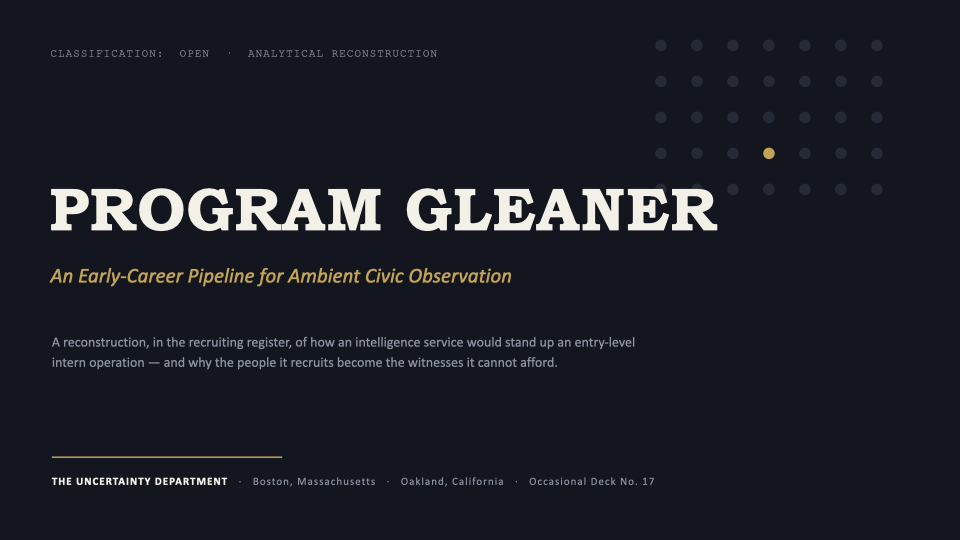
PROGRAM GLEANER

The Uncertainty Department — Office of Talent Acquisition (Unaffiliated Cohorts) · June 16, 2026

An analytical reconstruction of an early-career recruitment pipeline for ambient civic observation, and of the structural irony by which the unaffiliated cohorts it recruits become the witnesses the program cannot afford to have watching.

Policy Briefing
UD-OP-2026-019

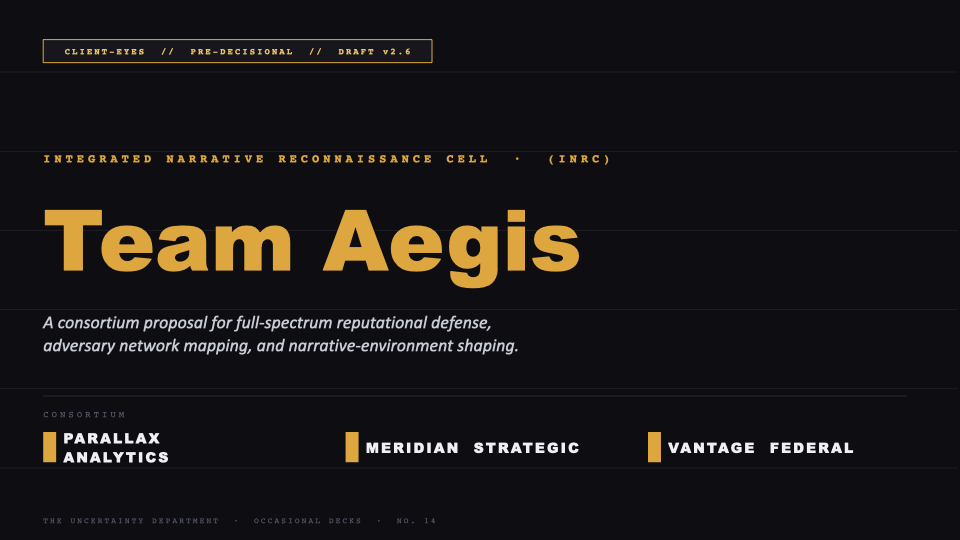
TEAM AEGIS

The Uncertainty Department · May 13, 2026

Combines an analytical reconstruction of a private-sector narrative-reconnaissance consortium's pitch deck with a companion analysis of how contracted vendors complete the deniable continuity architecture that agencies cannot build for themselves.

Policy Briefing
UD-RR-2026-031

The Open Market for Democratic Subversion

Dr. Priscilla Vane-Wortley, Program on Cognitive Infrastructure and Ambient Political Risk · April 12, 2026

This combined report documents the Uncontrolled Access Condition — a structural state in which politically actionable manipulation of American citizens at scale is available to any actor at negligible cost — and its companion phenomenon, Retroactive Leverage Accumulation, by which actors permitted to conduct such operations automatically accrue structural leverage over the government that permits them. Addendum A extends the analysis to individuated physical targeting operations with documented COINTELPRO and Stasi Zersetzung precedent, now available on the open market.

Policy Briefing
UD-OP-031

Negotiating with the General Idea of the United States

The Uncertainty Department, Occasional Papers Series · April 08, 2026

Foreign governments conducting negotiations with the United States are increasingly reporting Counterparty Opacity Syndrome — a pervasive uncertainty about whether the entity across the table constitutes, in any legally or politically meaningful sense, the United States government. This paper assesses agreement reliability in an era of franchise governance.

Policy Briefing
UD-MEMO-011

NINE EYES WIDE SHUT

The Uncertainty Department, Office of Structural Irony — Multilateral Division · April 04, 2026

An operational update to member delegations of the Coalition for Coordinated Epistemic Leverage regarding certain complications that have arisen from the collusive framework — specifically, that participating states have collectively replicated, at the multilateral level, precisely the structural liability they were attempting to exploit at the domestic level.

Policy Briefing
UD-ESSAY-009

The Epistemological Hostage

The Uncertainty Department · April 03, 2026

This report identifies a previously underdocumented liability structure arising from the sustained non-acknowledgment of directed domestic operations — a condition the authors term the Epistemological Hostage condition — in which a third party acquires a form of power over an institution's relationship with reality that was not supposed to be available to them.

Policy Briefing
UD-ESSAY-003

THE GEOMETRY OF INTERPRETIVE AUTHORITY

The Uncertainty Department · April 02, 2026

Argues that sustained covert operations against a witness systematically transfer interpretive and narrative authority from the operators to the person being watched, mapping the incompleteness problem and the authority drainage mechanism that drive the transfer.

Policy Briefing
PB-2026-0076

THE NARRATIVE RESOLUTION EXPENDITURE INDEX (NREI)

Archibald Ignacio, Vehicular Operations and Computational Sentiment Division · April 01, 2026

A Unified Framework for Correlating Vehicular Fuel Consumption, Machine Learning Compute Spend, and the Political Stability Requirements of Manufactured Narratives Whose Resolution Extends Past the Horizon of the Next Electoral Cycle

Policy Briefing
PB-2026-0042

On the Strategic Implications of Office Snack Allocation

Dr. Helena Fictitious, Senior Fellow · April 01, 2026

A rigorous analysis of break-room resource distribution and its second-order effects on organizational morale, with recommendations for a phased transition to demand-driven provisioning.

Policy Briefing
UD-ESSAY-002

THE DENIABILITY INVERSION LOOP

The Uncertainty Department · March 30, 2026

Analyzes the stable equilibrium in which a covert operation becomes widely known without becoming officially describable, and argues that knowledge without authoritative description functions as leverage rather than disclosure — producing self-perpetuating institutional paralysis rather than accountability.

Policy Briefing
UD-AS-2026-031

FIELD OPERATIONS MANUAL

The Uncertainty Department · March 22, 2026

A recovered field manual, prepared for cutout personnel operating in a denied cover environment, addressing the operational premise that both cutouts and the subject under observation are aware a larger process is occurring — an affiliation the manual declines to address directly, leaving it to its footnotes.

Policy Briefing
UD-MANUAL-004

INVESTIGATING DENIABLE OPERATIONS

The Uncertainty Department · March 15, 2026

A field manual for investigative journalists, oversight staff, and civil liberties attorneys examining tacitly sanctioned COINTELPRO-like activity, built around the systematic exploitation of the mundane residual records — fuel logs, scheduling, invoices — that deniable operations were never designed to sanitize.

Policy Briefing
OGE-2026-WP-014

THE NON-ZERO-SUM STRUCTURE OF UNANCHORED NARRATIVE CONTESTS

Valentina Cruse, Office of Game-Theoretic Epistemology · March 15, 2026

Why the Absence of an Authoritative Account Transforms a Narrative Contest from a Zero-Sum Competition into an Expanding-Field Variable-Sum Game, With Specific Reference to the Structural Position of the Subject and the Legal Constraints on Legitimate Media

Policy Briefing
UD-FRAMEWORK-IM-001

IDEOLOGICAL MATERIALISM: AN ANALYTICAL FRAMEWORK

The Uncertainty Department, Framework Development Working Group · March 01, 2026

Describes Ideological Materialism as a repeatable analytical framework for ideological transformation and institutional change, validated against cases including the Protestant Reformation, the Partition of India, Ottoman institutional collapse, and contemporary influence operations.

Policy Briefing
WP-GNR-001-ADDENDUM-A

THE IRAN WAR GASOLINE PREMIUM

Cornelius Fenwick Hartley & Marguerite Osei-Bonsu, Quantitative Methods Division · February 03, 2026

Geopolitical Fuel Cost Shock as a Compounding Multiplier on Outstanding Narrative Maintenance Debt, and the Dual Narrative Interference Problem

Policy Briefing
OISA-2026-047

OPERATIONAL REVIEW: THE AMERICANA PROBLEM

Wilhelmina Calloway-Strachey, Office of Legislative Oversight and Institutional Self-Awareness · January 28, 2026

A Formal Assessment of the Resource Costs, Strategic Incoherence, and Counterproductive Radicalization Effects of Extended Ambient Operations Against Subjects Whose Primary Characteristic Is Typicality

Policy Briefing
WP-GNR-001

THE GASOLINE-TO-NARRATIVE RATIONALIZATION INDEX (GNR-I)

Cornelius Fenwick Hartley, Quantitative Methods Division · January 14, 2026

A Framework for Quantifying the Accrued Narrative Maintenance Debt of Distributed Vehicular Surveillance Operations and Projecting Institutional Resolution Costs

Policy Briefing
UD-MANUAL-002

DEFENSIVE PSYCHOLOGICAL OPERATIONS FIELD MANUAL

The Uncertainty Department · November 29, 2025

A second-edition doctrine manual covering institutional operations (transparency requirements, platform regulation, algorithmic accountability), civic resilience networks (manipulation pattern recognition, front organization detection), and ambient countermeasures for democratic societies under adversarial information conditions.

Policy Briefing
DUC-2025-CORR-017

RE: POTENTIAL ALGORITHMIC IRONY IN YOUR POLICY PORTFOLIO

The Department of Unintended Consequences · August 17, 2025

An Unsolicited Notification to Elected Officials Regarding the Possibility That Their Own Technology Policy Preferences Have Created the Conditions Under Which Their Policy Preferences Are Now Being Manufactured

Policy Briefing
UD-BLOG-001

THE EROSION OF DEMOCRATIC FOREIGN POLICY

Dr. Octavia Fenwick-Marsh, Senior Fellow, Program on Democratic Governance and Strategic Affairs · July 30, 2025

Argues that U.S. foreign policy has diverged from democratic accountability and philosophical consistency through three interlocking forces — economic elite dominance over policy formation, transnational lobbying, and escalating partisan polarization — producing a triple legitimacy failure in American diplomacy since the end of the Cold War consensus.

Policy Briefing
UD-BLOG-005

THE RECOGNITION PARADOX

Dr. Camille Otieno-Reyes, Senior Fellow, Program on International Law and Governance · July 29, 2025

Examines Palestinian statehood as a diagnostic for the international system itself, arguing that the Montevideo Convention's formal criteria for statehood recognition are applied to Palestine with a consistency found nowhere else, exposing the gap between the law and the political economy that actually governs it.

Policy Briefing
UD-BLOG-008

A CENTURY OF MANAGED CRISIS

Dr. Leila Mansour-Fitzgerald, Senior Fellow, Program on Conflict Resolution and Transitional Justice · July 23, 2025

One hundred years after the British Mandate, examines why successive diplomatic frameworks for Palestinian governance — including the Oslo process — have failed, and argues that the conditions for a viable Palestinian state have been progressively destroyed under the protection of the same international framework that claims to pursue peace.

Policy Briefing
UD-ESSAY-005

THE DEMOCRATIZATION OF COGNITIVE WARFARE

The Uncertainty Department · July 18, 2025

Analyzes climate information warfare as a case study in cognitive security, tracing the neurobiology of manipulation and the technological acceleration toward a threshold at which sophisticated behavioral modification becomes available at consumer cost.

Policy Briefing
UD-BLOG-006

THE FEDERAL CITY PARADOX

Nathaniel Osei-Kwarteng, Policy Fellow, Program on Constitutional Structure and Democratic Accountability · July 04, 2025

Argues that Washington D.C.'s democratic deficit is not a technical constitutional problem awaiting a technical solution but a genuine, irresolvable tension between democratic representation and the federal interest in controlling the nation's capital — and maps a framework for managing that tension rather than solving it.

Policy Briefing
UD-BLOG-003

WHEN LIBERATION BECOMES CATEGORY MANAGEMENT

Dr. Renata Soriano-Bell, Research Fellow, Program on Political Ideology and Social Movements · July 01, 2025

Examines the displacement of liberation values by identity authenticity as the organizing logic of progressive politics, tracing how political authority shifted from the quality of analysis to membership in the identity category a framework addresses.

Policy Briefing
UD-BLOG-004

THE FOUR-PHASE ENERGY TRANSITION

Dr. Priya Nkemdirim-Wallace, Director, Energy and Climate Initiative · June 30, 2025

Models clean energy adoption as a predictable four-phase pattern in which policy, technology, finance, and social adoption must each cross a legitimation threshold, with a critical 2027–2030 window in which technological-financial alignment must be achieved for the transition to become irreversible.

Policy Briefing
UD-BLOG-002

THE OTTOMAN IMPLOSION

Prof. Alastair Vukovic-Huang, Senior Research Fellow, Program on Historical Systems Analysis · June 30, 2025

Argues that the Ottoman Empire's collapse between 1683 and 1923 was driven neither primarily by external pressure nor internal dysfunction, but by an irresolvable contradiction between the requirements of modernization and the sources of legitimacy the imperial system depended on.

Policy Briefing
UD-BLOG-007

THE WAR OF SYSTEMS

Dr. Yusuf Adeyemi-Kovacs, Senior Fellow, Program on Strategic Competition and International Order · June 22, 2025

Argues that contemporary proxy conflicts — Ukraine, Gaza, the Sahel, and Iranian-aligned proxy theaters — are best understood not as regional power competitions but as the primary arena in which Russia, China, and Iran are conducting a sustained campaign to rewrite the norms of the international order.

Policy Briefing
RB-ISRA-2024-0417

Wet Dreams of Scale

BRAN Institute for Strategic Resource Analysis, Emerging Technology & Environmental Security Program · April 17, 2024

A policy assessment of AI-generated adult content as a structurally invisible driver of data center water consumption, regional aquifer depletion, and transboundary environmental externalities. Per-session water evaporation may reach 1-27 liters for a single 30-minute AI adult video interaction, with aggregate freshwater demand functionally invisible in regulatory frameworks.