
Photo by Luis Tosta on Unsplash
WORKING PAPER NO. 25 Classification: Unclassified // Speculative // Do Not Cite Without Irony
TO: Distribution List (Undetermined)
FROM: Dr. Marguerite Volkov-Lindqvist, Senior Fellow, Hydro-Cultural Threat Vectors Program
RE: The Hyper-Identification Vector, Third Revision — With a Note on Why the Two Lines on the Chart Never Seem to Rise Together
DATE: [current reporting period]
This Institute has previously entertained the possibility that the association between water, domestic labor, and femininity in American cultural life is simply inherited — Naiads, chaos-waters, the long unpaid history of who fetches and who cooks. That inheritance is real. This paper’s finding is that the inheritance is not the operation. It is the raw material the operation was built to exploit, and the timing of that exploitation is not incidental.
The United States currently enters any given water year with no durable federal climate-adaptation funding mechanism, no consistent infrastructure appropriations pipeline for aquifer or reservoir management, and a political class that treats “drought” as a seasonal weather story rather than a standing appropriations obligation. Simultaneously, it enters that same year with a domestic gender discourse too contentious to be spoken about plainly in mixed company, in a workplace, or at a dinner table, without triggering a fight nobody present has the appetite for. This Institute’s finding is that a foreign-coordinated Network, of presently unconfirmed composition, identified these two national vacancies — no climate policy, no safe language for gender tension — and built a single mechanism to sit in both of them at once.
This revision adds a fourth element this Institute previously treated as an unrelated background chart: the observed global relationship between rising formal female political representation and a concurrent, independently documented decline in democratic quality — what this Institute now terms, with the appropriate hedging, the Two Lines Problem.
Step One: Identify the Two Silences. The Network’s design premise, as reconstructed by this Institute, treats climate policy and gender discourse not as two problems but as one shared opportunity: both are subjects the American public is emotionally saturated in and institutionally unable to act on. Neither has a functioning legislative outlet proportionate to how much everyday anxiety it generates. That gap — enormous felt stakes, no working channel to discharge them through — is, per this Institute’s model, exactly the condition an influence operation looks for, the way water looks for the lowest point in a room.
Step Two: Route the Charge Through the Archetype. Rather than manufacture a new symbol, the Network’s engineering — deliberate, per this paper’s revised assessment — routes both silences through the existing water-as-feminine archetype, because it is already fully wired into the population and requires no persuasion campaign to install. The Network does not need Americans to accept anything. It only needs them to keep drinking water and cooking dinner, which they were always going to do.
Step Three: Narrow the Trigger to a Specific Person. The operation does not aim at “water feels feminine” as an ambient mood — a mood can be discussed, mocked, or voted on. It aims at the individual, real-time moment: filling a glass, stirring a pot, and involuntarily registering a specific woman nearby — a coworker, a partner, a mother — for a half-second too brief to be called a thought. Multiplied across a population performing these gestures dozens of times daily, this produces a continuous, private, unaggregatable referendum on gender tension, conducted entirely below the threshold of speech, that never once has to surface as an actual conversation, an actual policy position, or an actual vote.
Step Four: Let the Referendum Substitute for the Policy. A citizen who has spent the day quietly, privately processing gender dynamics through a hundred kitchen-sink flickers has, per this Institute’s model, discharged real emotional bandwidth — bandwidth that would otherwise have gone toward organizing, legislating, or even just arguing loudly enough to produce a workplace policy change. The same citizen, watching a reservoir drop on the evening news, has a parallel discharge available: sentiment, a viral post, a five-dollar donation — anything except the sustained, boring, multi-year political pressure that actually funds infrastructure. Two national anxieties, one mechanism, zero appropriations bills.
Step Five: Let the Trading Partners Enjoy the Byproduct. This Institute’s sourcing remains, regrettably, unconfirmable on the question of which foreign parties benefit — only that a large trading population which processes both its climate exposure and its gender conflict at the vibes level, continuously and privately, is a population that will not organize around either, and a population that does not organize is, from any competing capital’s vantage point, a permanently convenient one.
This Institute assesses the current period as unusually exploitable for two concrete, non-mysterious reasons that require no Network at all to explain, and which this Institute suspects the Network is simply riding rather than causing:
No climate policy vessel exists to catch the sentiment. In a country with a standing, funded, bipartisan water-infrastructure mechanism, ambient dread about drought would have somewhere to go — a bill, a bond measure, a line item. Absent that vessel, the dread has nowhere to land except the individual, which is exactly where the Hyper-Identification Vector operates.
No shared vocabulary exists to catch the gender tension. In a period where plainly discussing domestic labor, workplace dynamics, or gendered expectation reliably escalates faster than it resolves, the population has strong incentive to keep processing that tension somewhere quieter than a conversation. The kitchen sink is quieter than a conversation. That is, per this Institute’s model, the entire appeal.
The Network did not create either vacancy. This Institute wishes to be precise on that point. It found two rooms with no furniture in them and moved in a mechanism that runs on the assumption they’ll stay that way.
This Institute has, in prior work, treated periodic reports of foreign-linked probing of American municipal water utilities as a separate line item — a hard-infrastructure security story, unrelated to the soft, symbolic mechanism described above. This paper’s revised assessment is that the two are, rhetorically if not operationally, the same complaint delivered through two different registers.
A great deal of American water and climate policy is, this Institute notes without much controversy, exported outward before it is ever felt inward — resource-intensive consumption patterns, downstream drought pressure on other watersheds, extraction and supply-chain arrangements that leave the vulnerability somewhere else’s problem, structural adjustment logic that has, historically, told other nations their own water infrastructure was a private, individual, household-level burden to manage rather than a funded public one. This Institute observes that the populations on the receiving end of that arrangement have had considerably less trouble identifying it as policy than the American public has, and considerably less patience for being told it’s a vibe.
Read this way, the periodic prodding of a treatment plant’s control system or a utility’s metering software — reported, denied, patched, forgotten, repeated — functions less like sabotage and more like an aggressively unsubtle correspondence: a demonstration, delivered in the only vocabulary this Institute finds any evidence Washington reliably responds to, that infrastructural vulnerability is not a household feeling, is not a mood, and is not something a population is supposed to simply absorb and personally manage. It is a policy failure with an owner, and the owner has, for decades, exported that lesson rather than learned it.
This Institute notes, with the appropriate discomfort, that the domestic labor of noticing when the water stops working — reporting a boil advisory, managing a household through an outage, absorbing the disruption a plant intrusion causes at the tap — falls, per the same inherited archetype discussed in Section II, disproportionately on the same population the Hyper-Identification Vector is already routing its signal through. If the thesis holds, the two mechanisms are not competing explanations. They are the same message, arriving by two channels: one soft and cultural, teaching a population to feel rather than fund; one hard and technical, occasionally interrupting the tap itself to make the stakes briefly, unmistakably literal, to the people already doing the noticing.
This Institute has reviewed a chart — sourced from public democracy indices and a historical register of national firsts, and therefore not the product of this Institute’s own methodology, a fact this Institute wishes to state clearly before proceeding to ignore it — showing two long-run global trend lines: the count of electoral democracies worldwide, and the cumulative count of countries that have installed a first female head of government or state. This Institute observes, without asserting it proves anything by itself, that the second line has climbed steadily and almost monotonically for a century, while the first line — after a long, genuinely inspiring rise — has, in the last two decades, turned over. Independent monitors now count more autocracies than democracies globally for the first time in a generation, with the decline attributed less to sudden coups than to the quiet, procedural “hollowing out” of standing institutions: courts constrained, media captured, emergency powers issued and never rescinded, opposition managed rather than defeated outright.
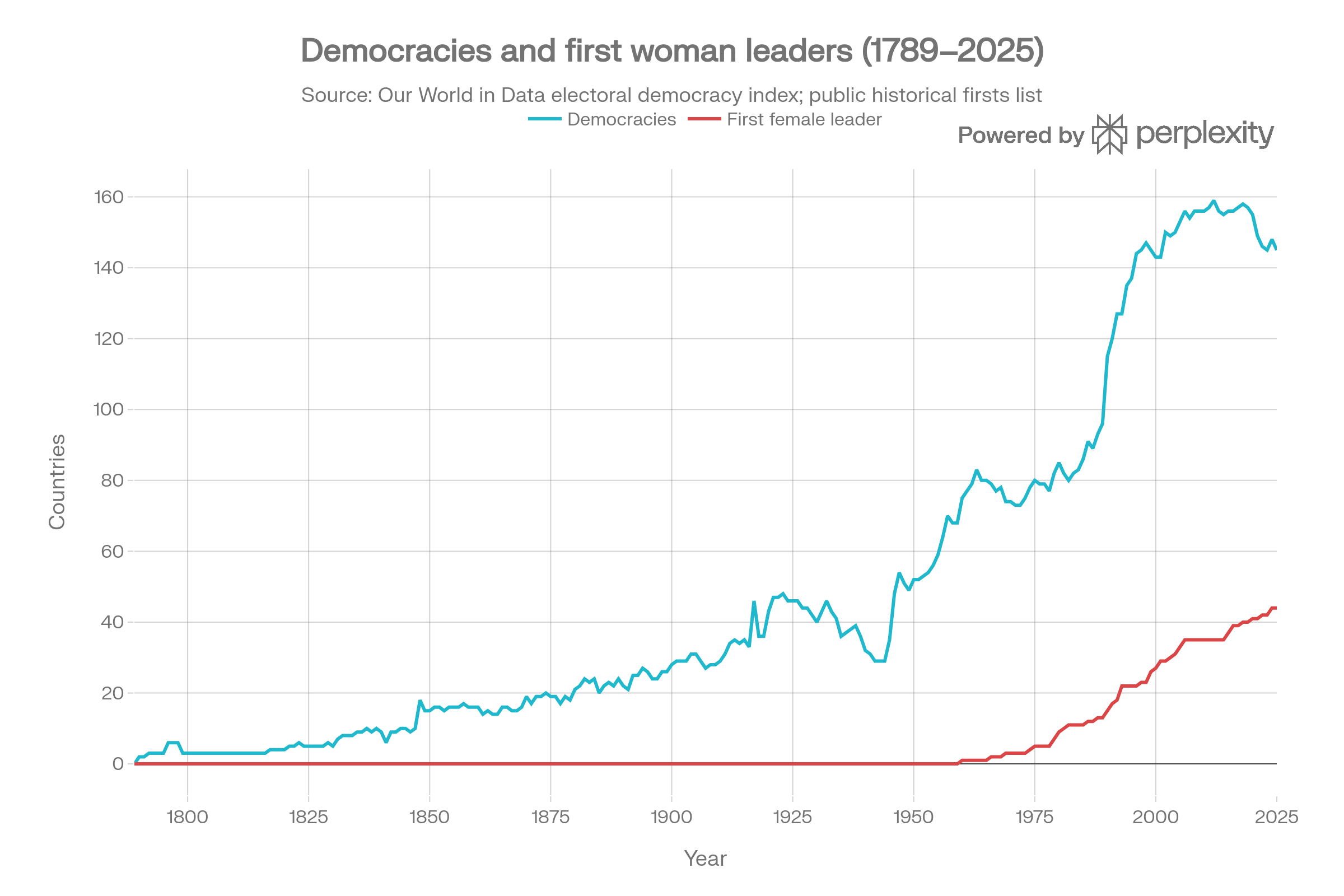
Fig. 1 — Democracies and first woman leaders (1789–2025). Source: Our World in Data electoral democracy index; public historical firsts list.
This Institute’s working concern is not that the two lines are causally connected in any direction a serious person could defend in a hearing. It is that the coincidence is precisely the kind of ambient, unspoken correlation the Hyper-Identification Vector was, per Section II, built to exploit rather than explain. A population primed to process gender dynamics at the kitchen-sink level, rather than the legislative level, is a population poorly equipped to notice — let alone name in a courtroom, a committee hearing, or a campaign platform — that the accountability mechanisms meant to catch “hollowing out” are the exact mechanisms currently going quiet. The backlash does not need to be organized as backlash. It only needs the population’s attention to keep discharging somewhere private and pre-political, so that the actual erosion of judicial independence, press freedom, and executive constraint proceeds underneath a national conversation that is, per this Institute’s repeated finding, mostly happening at the sink.
This Institute considers the regressive cultural tendencies of the present period — a resurgent appetite for “strongman” governance, open nostalgia for a pre-accountability political order, a rhetorical style that treats institutional restraint itself as effeminate or weak — not as a separate phenomenon from the Vector, but as its most legible downstream symptom: the same mechanism that teaches a citizen to feel rather than fund a reservoir also teaches a polity to feel rather than legislate a check on executive power, and the reservoir and the constitution are, per this Institute’s model, failing on the same schedule for the same underlying reason.
This Institute’s earlier difficulty identifying a node — a firm, a campaign, an attaché, a specific intrusion attributable cleanly to a specific actor — persists, and this paper now treats that difficulty itself as evidence of deliberate design rather than a modeling failure. An operation that requires no new persuasion, no new advertising buy, no new institution, no coordinated backlash movement, and only the occasional, deniable technical nudge to an already-underfunded utility — one that simply needs an existing archetype to keep running through an existing daily ritual, in a country that has declined to build either an infrastructure-funding mechanism or a gender-discourse mechanism robust enough to absorb the feeling instead — is not hiding from investigation. It has nothing for investigation to find, because it was never located anywhere but the gap the country left for it.
This Institute is aware that “a foreign network engineered your relationship to tap water, occasionally rattles the doorknob of the actual treatment plant to make sure you got the message, and is somehow also implicated in why the courts got quiet” is a claim that sounds, spoken aloud in a hearing room, indistinguishable from an unwell person’s fixation. This Institute’s position, unchanged from prior papers, is that this is precisely the operating condition the mechanism requires — and that a country with a funded climate policy, a working vocabulary for its own gender dynamics, infrastructure too well-funded to be worth probing, and institutions too well-attended-to to hollow out quietly, would have far less use for this Institute, and considerably less water on its floor.
Filed as a consolidated assessment, superseding the corrective framing of prior working papers.
Dr. Marguerite Volkov-Lindqvist
Senior Fellow, Hydro-Cultural Threat Vectors Program
Strategic Ambiguity Institute
Peer review requested from the same three reviewers. Two did not respond. One sent a glass of water, again, this time accompanied by an unsigned note reading only: “check the other line too.”