
Photo by Maksym Kaharlytskyi on Unsplash
Surveillance justified by a lawsuit that may never be filed does not stay idle. It becomes an asset, and assets attract investors. This briefing models how a single individual — hereafter Subject Zero, who has done nothing — can become the most strategically contested terrain in a case that does not exist.
Key findings:
Bottom line: the system has no off switch because no one is allowed to admit the case will never happen. Admitting it would end the preservation duty, the work-product shield, and the leverage — all at once.
No single rule creates the Cascade. It comes from five ordinary doctrines that were each designed to be reasonable on their own, and that were never introduced to one another.
1. The duty to preserve (the ignition). Under Zubulake v. UBS Warburg (S.D.N.Y. 2003) and Federal Rule of Civil Procedure 37(e), a party must preserve relevant information once litigation is “reasonably anticipated.” The rule exists to stop people from shredding evidence. Its unintended corollary is that anticipation itself becomes a recognized legal state, one any party can enter unilaterally and which obligates it to start keeping things. Keeping things about Subject Zero is a short step from collecting things about Subject Zero, especially when “preserve” is read generously by people paid by the hour.
2. Work product (the vault). Hickman v. Taylor (1947) and Rule 26(b)(3) shield materials “prepared in anticipation of litigation” from discovery. The same anticipation that obligates preservation now also protects whatever was gathered. The file is mandatory to keep and difficult for anyone else to see. Including Subject Zero.
3. Third-party doctrine (the supply chain). Smith v. Maryland (1979) and United States v. Miller (1976) hold that information voluntarily shared with third parties carries a reduced expectation of privacy. Subject Zero’s bank, phone carrier, landlord, apps and dentist are therefore not walls but warehouses. Private parties cannot invoke the Fourth Amendment’s government-search framework at all, but they can subpoena, purchase data, or simply ask the warehouse nicely.
4. Mosaic theory (the appreciation curve). In United States v. Jones (2012, concurrences) and Carpenter v. United States (2018), the Court recognized that aggregated data reveals far more than its individual pieces. The Court offered this as a reason for restraint. The Cascade treats it as a pricing model: each additional tile increases the value of every other tile already held.
5. Standing (the lock on the door). In Laird v. Tatum (1972), a subjective chill from government surveillance was not enough to sue. In Clapper v. Amnesty International USA (2013), plaintiffs lacked standing because their injury relied on a “speculative chain of possibilities” and was not “certainly impending.” This is the central irony of the briefing. The watchers’ authority rests on litigation that is merely anticipated. Subject Zero’s ability to complain requires harm that is certainly impending. The watchers’ standard is foresight. The watched party’s standard is proof.
Two supporting doctrines round out the architecture. Rule 27 lets a party depose witnesses before a suit is filed to perpetuate testimony — a statutory acknowledgment that the future lawsuit can generate procedure in the present. And the Noerr-Pennington doctrine protects petitioning activity, including litigation, from many forms of liability, so long as it is not a “sham.” Determining whether a never-filed lawsuit is a sham is left as an exercise for the reader.
The Cascade is a self-reinforcing loop. It needs no lawsuit, only someone who can afford to anticipate one.
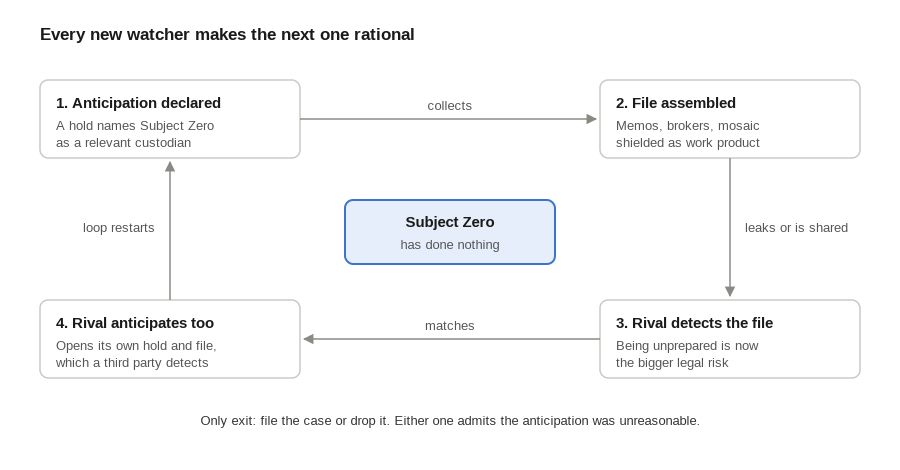
The Anticipation Cascade · four stages, no exit ramp
Each stage is locally rational. A party that has detected a rival’s file faces a classic security dilemma: by preparing defensively, it becomes evidence that the matter is serious, which justifies the rival’s file, which justifies its own. Robert Jervis described this spiral for arms races. Here the warheads are PDFs.
Three dynamics accelerate the loop:
Subject Zero is not a party, a witness, or a suspect. Subject Zero is a venue. In classical deterrence theory, territory is valuable because an adversary might want it. Subject Zero’s value is identical, except that the territory is a person’s text messages and the adversary is a hypothetical litigant.
Subject Zero’s typical relationship to the anticipated case:
The Ghost Docket. Collectively, the parties watching Subject Zero maintain what analysts term a Ghost Docket: an unfiled case with an active evidentiary record, multiple interested parties, a body of privileged strategy memos, and no judge. The Ghost Docket has every feature of litigation except accountability. It cannot be dismissed, because it was never filed. It cannot be settled, because no one is a plaintiff. It cannot be appealed, because nothing has been decided. It can only grow.
The Inversion Effect. As files on Subject Zero accumulate, their combined weight starts to function as evidence that something must be going on. Parties new to the situation observe that several sophisticated organizations are monitoring Subject Zero and reasonably infer that Subject Zero matters. This inference satisfies their own “reasonable anticipation” threshold. Subject Zero has become suspicious entirely by being watched — the surveillance has generated its own probable cause, retroactively and in the passive voice.
Discovery as currency. Because work product is protected but not inherently exclusive, files can be shared under a common-interest arrangement between parties whose interests are temporarily aligned. In practice this produces a secondary market in Subject Zero, with parties trading access to each other’s anticipations. Political actors find this market especially attractive: a file on an uninvolved person cannot be attacked as opposition research, because officially it is litigation preparedness.
In the tradition of Cold War escalation studies, the Department has identified nine rungs. No rung requires a lawsuit to exist. Each rung is individually defensible in a deposition.
| Rung | Name | What happens | Doctrinal cover |
|---|---|---|---|
| 1 | Ambient Concern | A general counsel says “this could become a thing” in a meeting | None needed; it’s a feeling |
| 2 | The Hold | A litigation hold names Subject Zero as a “relevant custodian” of nothing in particular | Duty to preserve; Zubulake |
| 3 | The Memo | Investigators summarize Subject Zero’s public life “for counsel” | Work product, Rule 26(b)(3) |
| 4 | The Warehouse Visit | Data brokers, vendors, and records custodians are approached | Third-party doctrine (by analogy) |
| 5 | Mosaic Assembly | Fragments are combined into a pattern that implies a narrative | Carpenter logic, inverted |
| 6 | Rival Detection | A second party learns of the file and opens its own | Its own “reasonable anticipation” |
| 7 | Common-Interest Swap | Allied parties share files; rivals hire to match | Common-interest privilege |
| 8 | Political Monetization | The file is used to signal, threaten, or bargain over unrelated matters | Noerr-Pennington, pending the sham question |
| 9 | Ghost Docket Maturity | Subject Zero’s file is now more consequential than Subject Zero | Mootness avoided: “capable of repetition, yet evading review” |
Rung 9 is stable. Analysts have found no historical instance of a party voluntarily descending the ladder, as descending would constitute a written admission that its anticipation was unreasonable.
The Department evaluated four interventions. Each is presented with its most likely institutional fate.
Recommendation. The Department recommends Option 4, while acknowledging that its recommendation is itself now a document someone may reasonably anticipate litigating over. This briefing has been placed on hold accordingly.
The satire runs on real law. The cases and rules below are cited for what they actually hold. The exaggeration is only in how this briefing chains them together. Citations come from general legal knowledge and were not freshly pulled for this draft; check them before you rely on any of them.
| Authority | What it actually holds | Satirical use here |
|---|---|---|
| Zubulake v. UBS Warburg, 220 F.R.D. 212 (S.D.N.Y. 2003) | The duty to preserve attaches once litigation is reasonably anticipated | Anticipation as a self-certifying legal state |
| Fed. R. Civ. P. 37(e) (2015 amend.) | Sanctions for failure to preserve electronically stored information | The fear that drives over-collection |
| Hickman v. Taylor, 329 U.S. 495 (1947); Rule 26(b)(3) | Protects materials prepared in anticipation of litigation | The file is shielded by the same speculation that created it |
| Smith v. Maryland, 442 U.S. 735 (1979); United States v. Miller, 425 U.S. 435 (1976) | Reduced privacy expectation in data given to third parties | Subject Zero’s vendors as warehouses |
| United States v. Jones, 565 U.S. 400 (2012); Carpenter v. United States, 585 U.S. 296 (2018) | Aggregated location data can be a search; mosaic concerns | Mosaic as a pricing model |
| Laird v. Tatum, 408 U.S. 1 (1972) | A subjective chill from surveillance does not confer standing | Subject Zero cannot sue over feeling watched |
| Clapper v. Amnesty Int’l USA, 568 U.S. 398 (2013) | Injury must be certainly impending, not a speculative chain | The asymmetric-speculation problem |
| Fed. R. Civ. P. 27 | Depositions before an action is filed, to perpetuate testimony | Future suits generating present procedure |
| Noerr-Pennington doctrine | Immunity for petitioning activity, except for shams | Is an unfiled suit a sham? |
| “Capable of repetition, yet evading review” | An exception to mootness | The Ghost Docket’s immortality |
Note on scope: Fourth Amendment doctrines limit government action. Private parties are mostly governed by discovery rules, privacy statutes, and tort law. The briefing’s mixing of public and private surveillance logic is deliberate, and it is the joke.