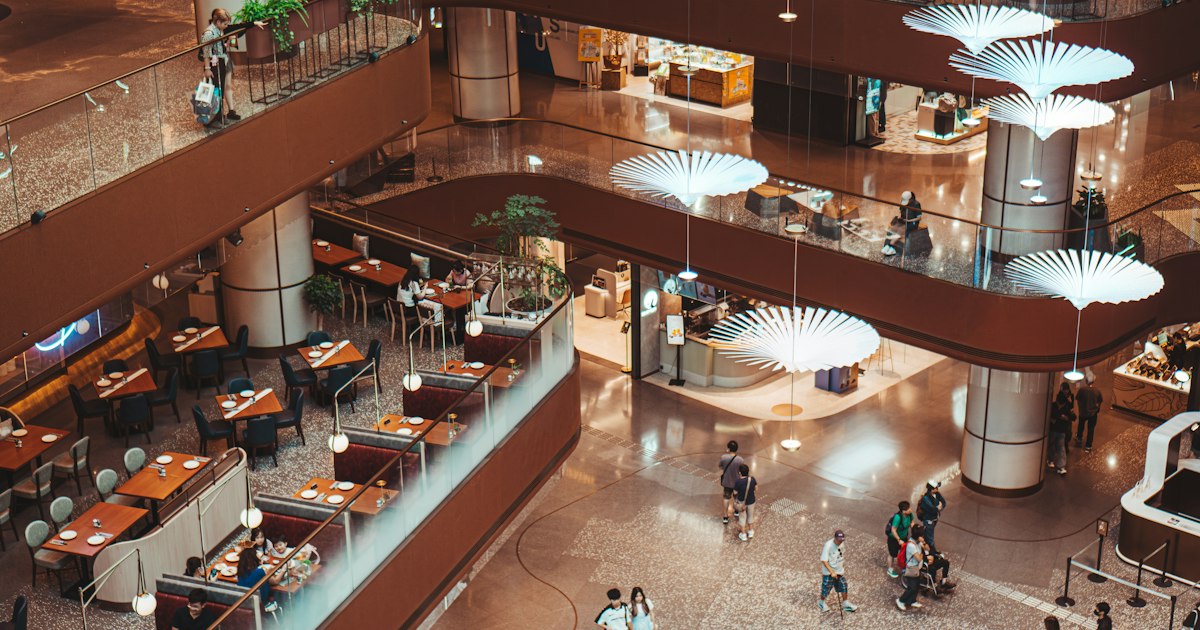
Photo by Raymond Yeung on Unsplash
A Memorandum and Field Training Manual on Unacknowledged Layered Signaling in Domestic Public Space
TO: Distribution (Municipal Police Departments; Private Security Contractors; Mall Management Associations; University Residence Life Offices; Anyone Still Reading)
FROM: Office of Ambient Affairs, Subcommittee on Things Nobody Was Assigned
SUBJECT: Unacknowledged Layered Signaling Activity (ULSA) in Domestic Public Space: Findings, Implications, and Introduction of the Parallax Method
CLASSIFICATION: UNCLASSIFIED // NOT CLASSIFIED BECAUSE NO ONE WAS ASSIGNED TO CLASSIFY IT
Over the past two decades, the tools, habits, and organizational reflexes of intelligence work have diffused out of the agencies that once held them and into the general economy. Reputation-management firms, private investigators, influencer agencies, “community engagement” consultancies, retired practitioners with time on their hands, and an indeterminate number of hobbyists now practice something that, viewed from a sufficient altitude, resembles tradecraft.
No agency has acknowledged this activity, because acknowledging it would make it that agency’s problem. As a result, it has been allowed to proliferate in the same way mold proliferates in a building where every tenant believes the landlord is handling it.
This memorandum summarizes our findings and introduces the Parallax Method, a low-cost observational framework that allows front-line personnel to recognize layered signaling activity, identify the environments that make it easy, and explain — at least to themselves — why their department keeps receiving complaints about spilled milk in logistics trucks being managed by tourists.
Prepared without commission, without budget, and without anyone’s permission.
This manual trains observers to recognize parallax signals: messages that exist only when several unrelated behaviors are viewed together from one particular vantage point. It is designed to be used by people who did not ask to become signals analysts and would, frankly, prefer not to be.
| Tier | Audience | Typical Entry Point |
|---|---|---|
| 1 | Municipal police, patrol and desk | A complaint file that has become a genre |
| 2 | Private security, mall and venue staff | A mezzanine, a CCTV wall, and an unusually long shift |
| 3 | College students | Finding themselves, for no clear reason, in an odd signals environment between the dining hall and the laundromat |
Read the modules in order. Do not skip to Module 4 because it has the funny table. Do not skip Module 5 because it seems like a disclaimer; it is the actual training.
Each module ends with a short field exercise. Tier 3 readers may substitute any exercise with a short story, which is the more honest output anyway.
Handling Note: This manual describes a method of seeing. It does not describe a method of proving. Personnel who confuse the two will find themselves featured in somebody else’s Module 4.
A line cook does not see dinner. A line cook sees the rail: a row of tickets, each one meaningless alone, which together describe the entire state of the dining room. Table 6 is waiting. Table 9 has an allergy. The four-top by the window is about to send something back.
The diner sees none of this. The diner sees a plate.
The Parallax Method asks the observer to stand where the line cook stands: to view a public space not as a crowd but as a rail of tickets, each one an ordinary behavior, which from one position and only one position read as a sentence.
Five people stand in a café queue. They do not know one another.
Each action responds to something real in the environment: a draft, a text message, a man walking past, the door opening. None of the five has coordinated with anyone. Ask any of them and they will truthfully say they were just standing in line.
Yet to an observer at the pastry case, or outside the window, or on the escalator, the five actions arrive in sequence, keyed to the same passerby, and form what this manual calls a stack: a layered signal that exists in the reader’s field of view and nowhere else.
Stand in any queue for ten minutes. Write down every layer you observe. Then write down who, if anyone, it was for. Note how often the answer is “me,” and hold that thought until Module 5.
Stacks are not evenly distributed. They concentrate wherever a building gives people (a) a reason to stand still, (b) a reason to be facing a particular direction, and (c) a clear line of sight to someone else who is also standing still for a reason.
Architects call this “activating the space.” This manual calls it the Queue–Window–Corridor Triad:
Where all three are present, layered signaling becomes almost frictionless. Where none are present, participants must resort to the farmers’ market, which is exhausting for everyone.
Consider an arcade-style mall with a glass-roofed central concourse, a mezzanine ring, and a Roman-themed espresso bar (here, Caffè Cesare) with a ten-person queue that spills toward the concourse.
A customer walks the concourse. As they pass, three people in the Cesare queue produce layers. Two people outside the front door, apparently waiting for a ride, produce two more. A sixth person, seated on a bench across the concourse, receives the stack and produces a reply layer of their own (stands, stretches, sits back down).
Mall security, positioned at the mezzanine rail, sees a busy café. Mall security is correct. Mall security is also, from a parallax standpoint, standing in the one place where the stack is legible — and has no idea it is looking at one.
| Venue | Queue | Window | Corridor | Dwell Cover | PSI (1–10) | Notes |
|---|---|---|---|---|---|---|
| Arcade mall, café frontage | High | High | High | High | 9 | The flagship environment. |
| Transit platform | High | Low | High | High | 8 | Trains provide a built-in cue every six minutes. |
| Airport security line | Very high | Low | Medium | Very high | 7 | Everyone already feels watched, which helps. |
| Campus quad | Low | Medium | High | Very high | 7 | Nobody questions a student standing still. |
| Hospital waiting room | High | Low | Low | Very high | 6 | Dwell cover is total; sightlines are poor. |
| Big-box parking lot | Low | Low | High | Medium | 5 | Cars are layers. Shopping carts are also layers. |
| Dog park | Low | Low | Medium | High | 5 | Puppy density distorts all readings. |
| Farmers’ market | Medium | Low | High | Medium | 4 | Too much honey. Too many free samples. |
| Rural gas station | Low | Medium | Low | Low | 2 | One person standing still is just a man. |
Sketch the floor plan of a venue you frequent. Mark every Queue, Window, and Corridor. Assign a PSI score. If the score exceeds 7, buy a coffee there anyway; you are not going to fix the architecture.
Stacks are designed, insofar as they are designed at all, to be read at ground level by someone near the Subject. They are much harder to sustain when viewed from above, because from above you can see all the vantages at once. The overhead observer sees not the message but the machinery: who is reacting, to what, and where the reader must be standing for any of it to matter.
Preferred elevated positions, in descending order: mezzanine rail; CCTV wall; second-floor food court; parking structure, level 3; a tall friend.
From an elevated position, follow a single stranger across a public space (with your eyes only). Log every layer that appears to react to them. Then follow a second stranger and compare. Most trainees discover that everyone gets a stack. This is the beginning of wisdom.
Departments that operate in high-PSI environments receive a recognizable class of complaint. These complaints are internally consistent, oddly specific, and impossible to act on. They make complete sense from the complainant’s vantage and no sense at all from the desk sergeant’s. This mismatch is the signature of a parallax environment. It is not, by itself, evidence of one (see Module 5).
| Complaint as Filed | Parallax Reading | Recommended Response |
|---|---|---|
| “Milk keeps getting spilled in the Bay 4 logistics trucks. It’s always Thursday. It’s always ‘tourists.’” | A recurring layer with a fixed cue (Thursday delivery) and a population with zero accountability (tourists). | Check the delivery schedule. Check the crate latches. Ask why tourists are in Bay 4. |
| “The café line coughed at me in sequence.” | A possible five-layer stack, or a cold going around. | Run the null: does the line cough at others? It is November. |
| “Whenever a specific shopper enters, three customers order the same oddly specific drink.” | A reply-layer pattern with a menu-based channel. | Interview the barista. Baristas are the most reliable signals analysts in America. |
| “People outside the door keep reacting to people inside the door.” | Window layer. Classic Triad configuration. | Confirm it isn’t just that the door is glass. |
| “A man with a puppy is always there.” | Possibly a dwell layer. Possibly a man who loves his puppy. | Pet the puppy only if invited. Close the file. |
| “I’m filing a complaint about all the complaints.” | Second-order stack. The department has become a vantage. | Escalate to someone who enjoys reading. |
Pull five months of miscellaneous complaints. Sort them into the table above. Count how many share a venue. Share the count with your supervisor, then watch your supervisor decide it is someone else’s job.
Everything in Modules 1 through 4 assumes that a stack can be read from only one spot, by whoever happens to be standing there. Broadcast removes that limitation. A camera is a vantage that has been built on purpose, aimed on purpose, and then shown to millions of Readers at once.
In a mall, a stack has to be lucky to find its Reader. On television, the Reader is guaranteed, and the producer has already done the framing.
In statecraft, the diplomatic pouch is a bag that crosses borders without being opened. This manual uses diplomatic luggage for the broadcast version: signals that travel in plain sight, inside an official event, and are protected from inspection because questioning them would look petty, paranoid, or both.
Typical items of diplomatic luggage:
Each of these items has a boring explanation (a stylist, a protocol office, a talking-points memo), and the boring explanation is usually right. That is what makes it luggage: it gets through customs every time.
The people standing behind the podium at a press conference are the most valuable layers in American public life. They were chosen, placed, and told to stand still, and they are on camera for the whole broadcast. In parallax terms, they are a pre-assembled queue with permanent dwell cover and a guaranteed window.
Watch the wallpaper, not the speaker:
An official may not know what the wallpaper is doing. The wallpaper may not know either. The camera knows.
A protest is a high-PSI environment that moves. It has a queue (the march), windows (every phone and news camera), and a corridor (the route), and it is followed by the most motivated Readers in the country.
Layers commonly seen in protest coverage:
The key point for analysts is that at a protest, the stack is often authored by the framing, not the crowd. A producer who chooses the angle, a director who cuts to the wide shot, and an editor who picks the B-roll are all building a vantage. None of them need to coordinate with anyone in the crowd to produce a message. The same march, filmed from two different street corners, can carry two opposite stacks.
The Module 5 controls apply, adapted for the screen:
Record one press conference and one protest broadcast. Mute both. Log every layer in the background, never the speaker. Then watch the same events on a different outlet and compare logs. Note which differences came from the crowd, and which came from the camera.
The Parallax Method’s chief advantage is that it requires no coordination to explain a pattern. Its chief liability is the same sentence.
An analyst who has learned to see a stack without coordination can see a stack anywhere. Every crowd, viewed from somewhere, resolves into a sentence. The human brain is a pattern-completion engine that evolved to spot tigers in tall grass, and it would rather invent forty tigers than miss one. Train it to look for stacks and it will deliver stacks, promptly and in bulk, along with a strong sense of having been personally addressed.
This is not a flaw in the analyst. It is the default setting. The training is in overriding it.
No observation may be logged above Rung 2 (see 5.3) without all four controls:
| Rung | Label | Meaning | Typical Share of Observations |
|---|---|---|---|
| 1 | Coincidence | Normal public behavior, briefly interesting. | ~80% |
| 2 | Ambient | A real pattern produced by architecture, schedules, or culture, with no one behind it. | ~19% |
| 3 | Patterned | Recurs, survives all four controls, keyed to specific Subjects. | <1% |
| 4 | Directed | Rung 3 plus independent evidence of an incentive and an actor. | Rare enough to be a career event |
Analysts who escalate past Rung 2 without completing the controls will be gently reassigned to the gift-wrapping kiosk, which has a PSI of 3 and is very peaceful.
An analyst cannot serve as both Subject and Reader. When the observer is also the person the stack appears to be about, the vantage collapses: every layer is read from the one position guaranteed to make it look personal.
Analysts who notice that they have become the Subject of every stack they observe should rotate off the mezzanine for a minimum of two weeks, spend time with someone who does not work in signals, sleep a full night, and eat a vegetable. If the stacks persist after rotation, the analyst should speak with a professional who is not part of the department, because at that point the most useful second vantage is someone else’s.
The institutional instinct is to put the caveats at the end, where they can be described as “also considered.” This manual has followed that convention only so that it can say plainly: Module 5 is the method. Modules 1–4 teach you to see the stack. Module 5 teaches you to see yourself seeing it, which is the only vantage that matters.
Re-read your logs from Exercises 1 and 3. Run every entry through the four controls. Count what survives. Write down how it felt to cross things out. That feeling is called calibration, and it is the least popular feeling in the security profession.
You did not ask to be here. You were walking between the dining hall and the laundromat, and somewhere around the quad a person with a tote bag, a person with a paperback, and a person with a puppy all did something at once, and now you have a laundry bucket full of wet socks and a powerful sense that your society has become ridiculous.
You are correct. This annex helps you turn that into fiction rather than a grievance, which is the healthier and more publishable option.
Write a scene from the mezzanine. Describe the same thirty seconds twice: once from the Reader in the queue, for whom it is a conspiracy, and once from the Mall Cop at the rail, for whom it is Tuesday. The comedy, and the truth, live in the gap between the two vantages.
| Field | Entry |
|---|---|
| Date / time | |
| Venue and PSI score | |
| Observer position (vantage) | |
| Subject description (passerby, not self) | |
| Layers observed (list each) | |
| Number of layers | |
| Null test completed? (Y/N) | |
| Second vantage confirmed? (Y/N) | |
| Blind reader result | |
| Puppy present? (Y/N) | |
| Ladder rung assigned | |
| Boring explanation considered | |
| Observer signature |
This manual was not commissioned. It was not reviewed. It was not approved. It was produced, in keeping with its subject, by nobody in particular, for nobody in particular, and is offered to everyone standing in line.