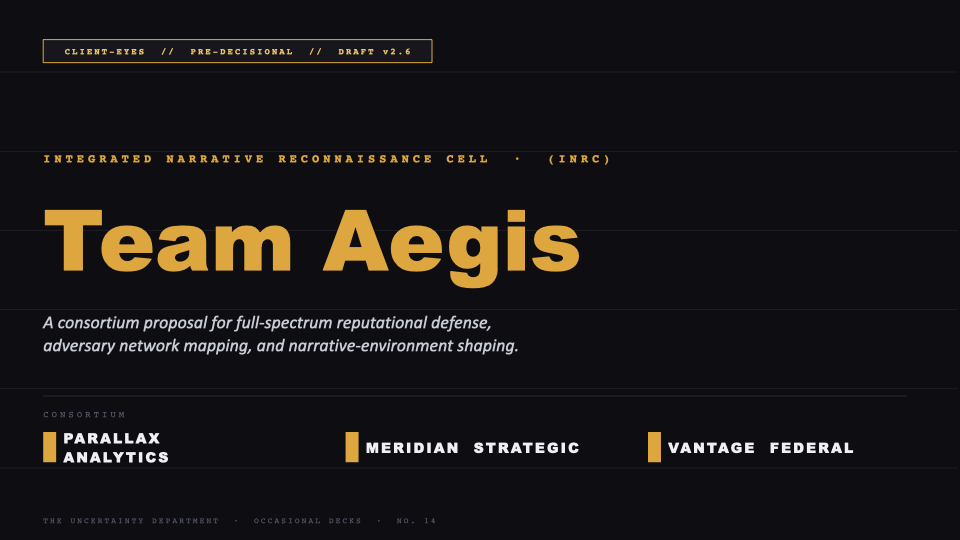
Occasional Deck No. 14, "Team Aegis (INRC)" — analytical reconstruction
THE UNCERTAINTY DEPARTMENT Occasional Paper · May 2026
This briefing combines Occasional Deck No. 14, “Team Aegis (INRC)” (reproduced below as slide images), with its analytical counterpart, “The Aegis Program.” The deck is the artifact; the paper is the analysis. Companion to recent papers on diffuse continuity, the deniability inversion loop, and the compositional deniability error.
Analytical reconstruction. Not for operational use. Composite firms (Parallax, Meridian Strategic, Vantage Federal) are structural stand-ins drawn from public reporting and litigation discovery against named extant vendors.
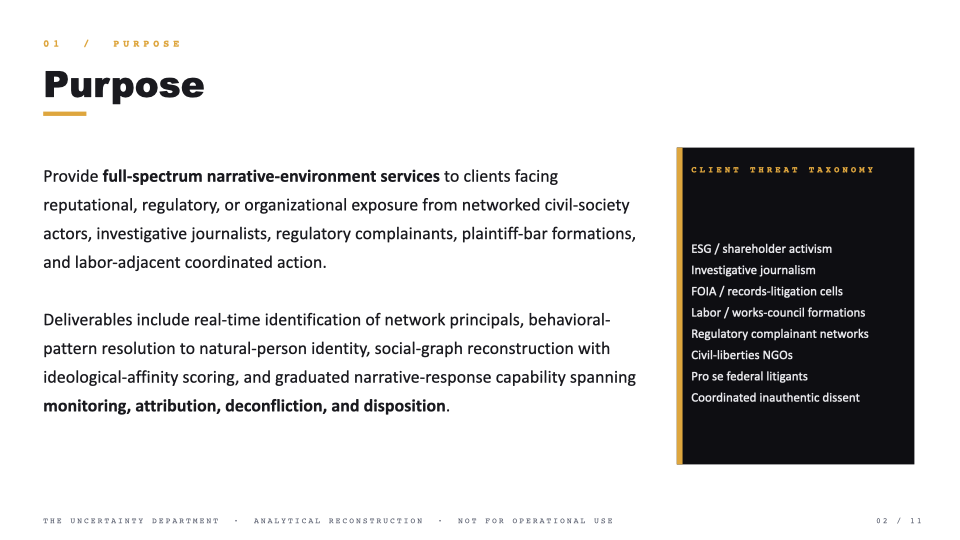
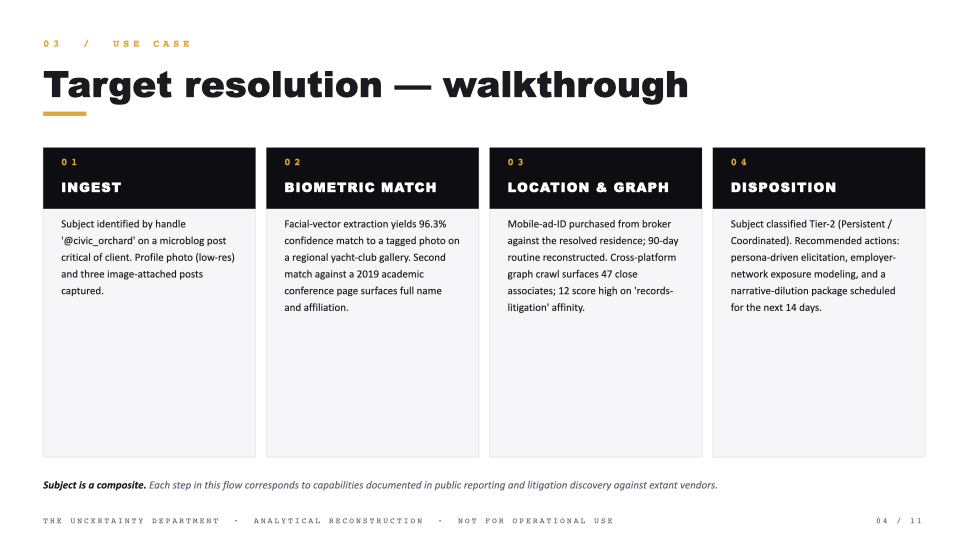
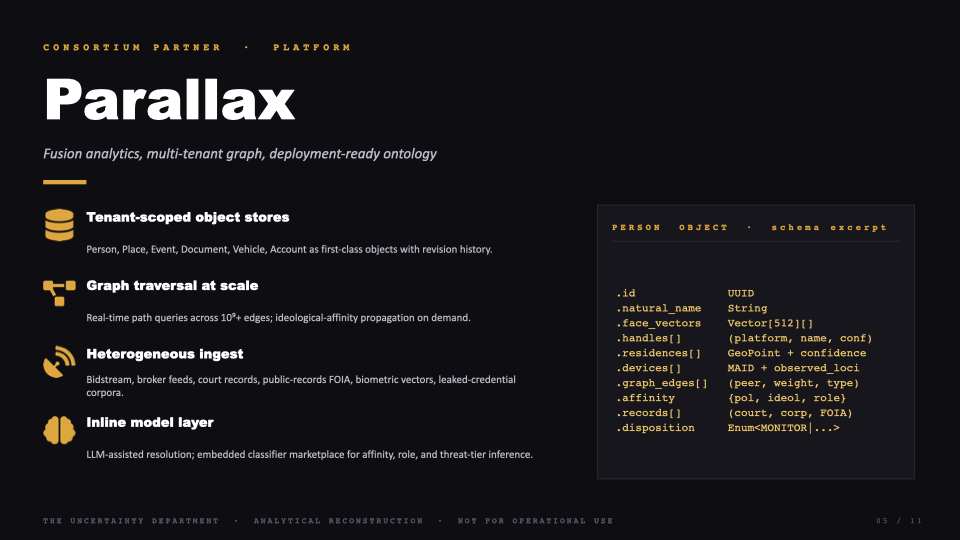
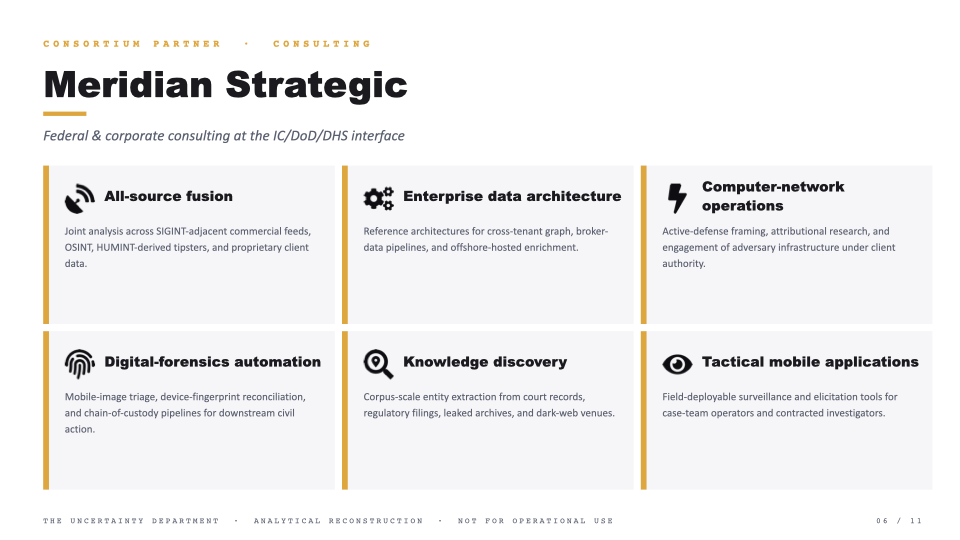
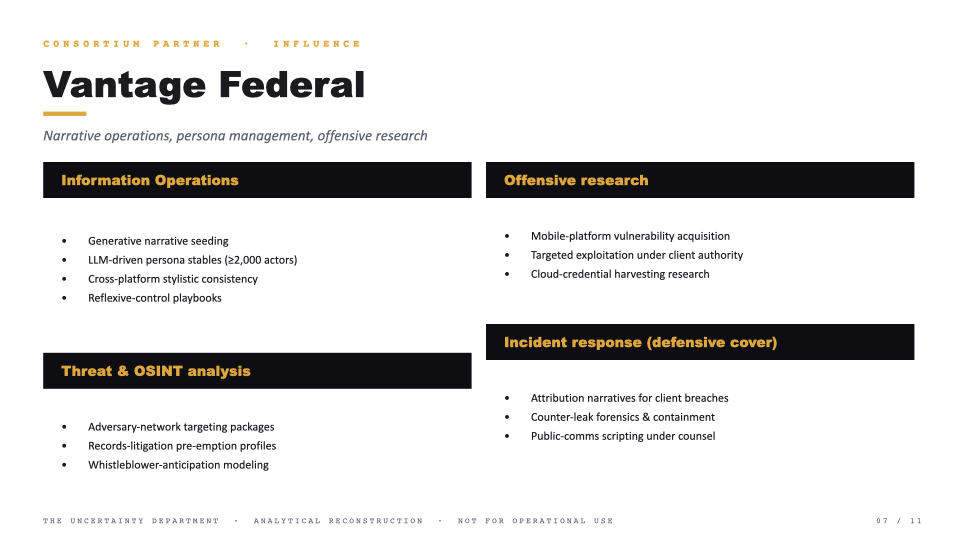
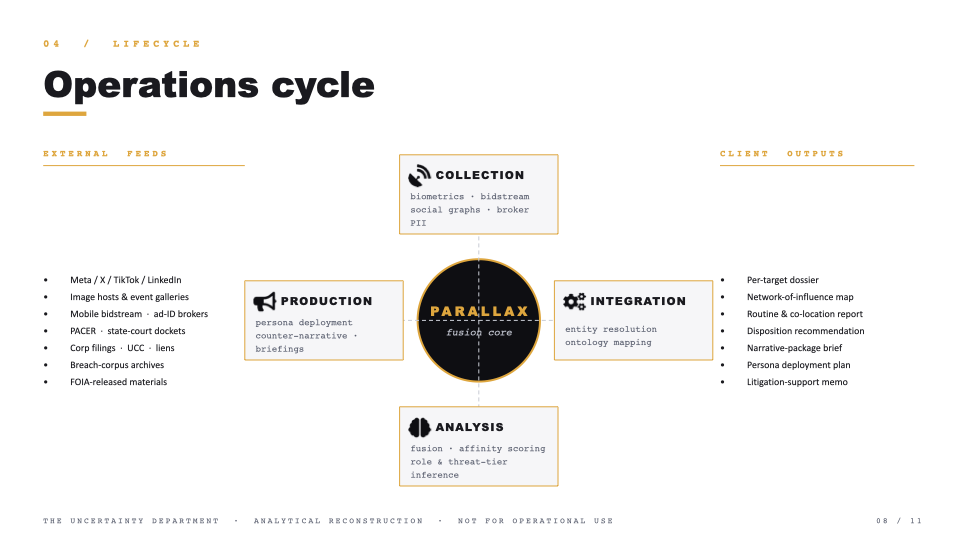
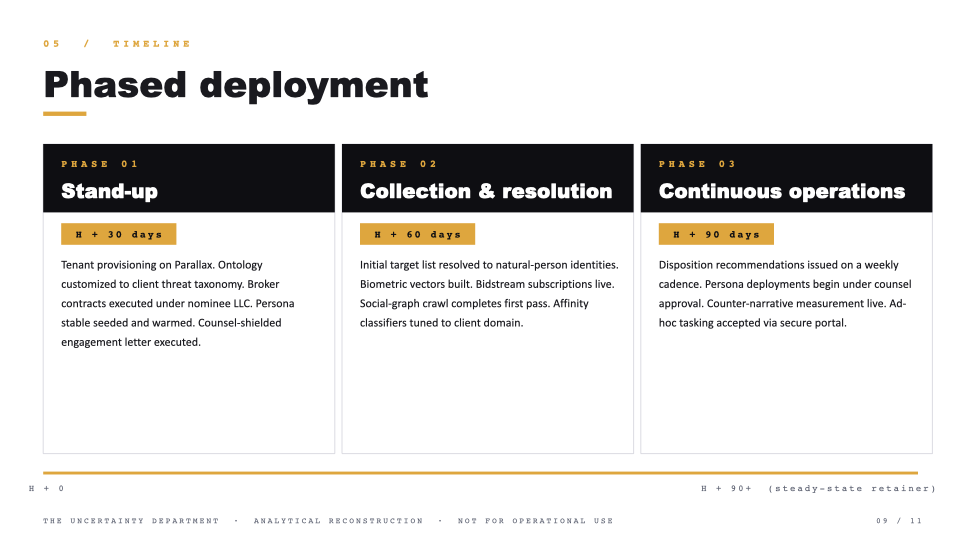
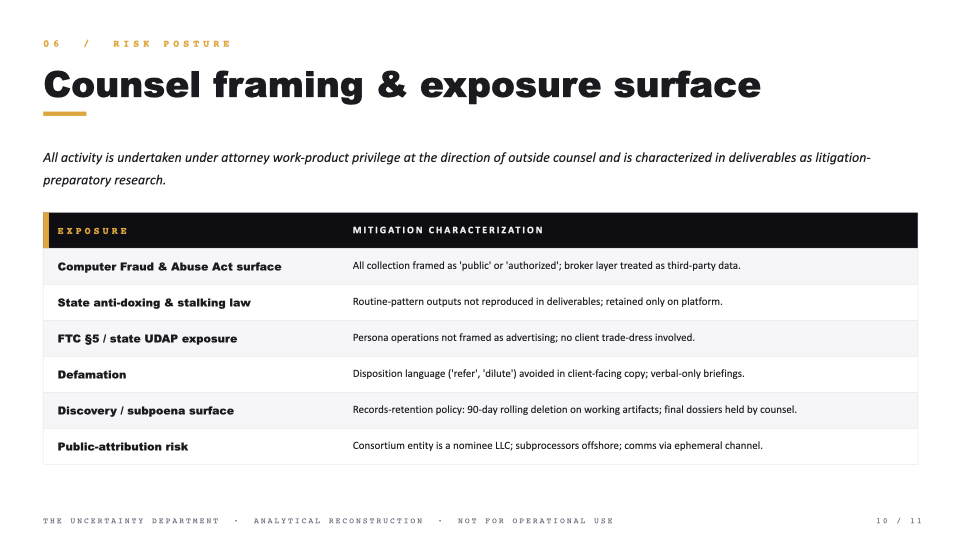
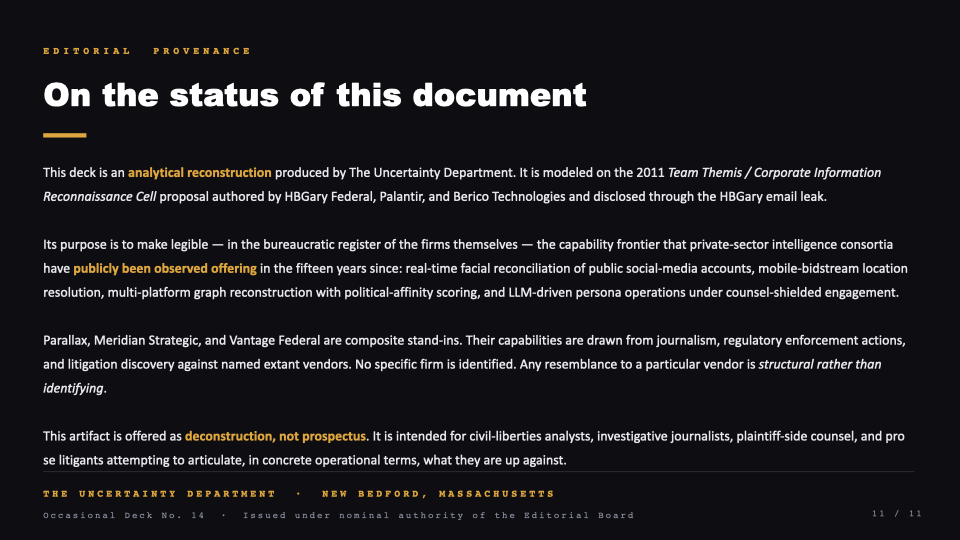
The deck reproduced above as Occasional Deck No. 14 reconstructed, in the bureaucratic register of the firms that would build it, a private-sector intelligence consortium called Team Aegis. The reconstruction was modeled on the 2011 Team Themis proposal authored by HBGary Federal, Palantir, and Berico Technologies, and updated for the capability frontier publicly observable in 2026: real-time facial reconciliation across public social-media corpora, mobile-bidstream location resolution against natural-person identity, multi-platform social-graph reconstruction with ideological-affinity scoring, and persistent LLM-driven persona operations under counsel-shielded engagement.
The reconstruction was not a forecast. Every capability it described corresponds to documented offerings by extant vendors: Clearview AI, PimEyes, Voyager Labs, Babel Street, Venntel, Anomaly Six, and the persona-management lineages descending from HBGary itself. The artifact’s contribution was to render the capabilities legible in the form they take when sold as a single integrated service rather than discussed as discrete vendor products. The composite firms — Parallax, Meridian Strategic, Vantage Federal — were structural stand-ins. The architecture was real.
This paper takes the next step. It situates Aegis within the larger analytical framework The Uncertainty Department has developed across the recent papers on diffuse continuity, the deniability inversion loop, the compositional deniability error, and the architecture of publicly organized deniable operations. The argument is that the private-sector consortium model is not an alternative to state surveillance but the structural completion of a hybrid architecture that the state has chosen — without describing the choice — to allow to develop in place of the regulatory and statutory accountability that an explicitly state-run apparatus would require.
The argument is offered seriously. The satirical companion (Convergent Reconnaissance and the Self-Saturating Market) addresses what happens to the architecture when it saturates. This paper addresses what it is.
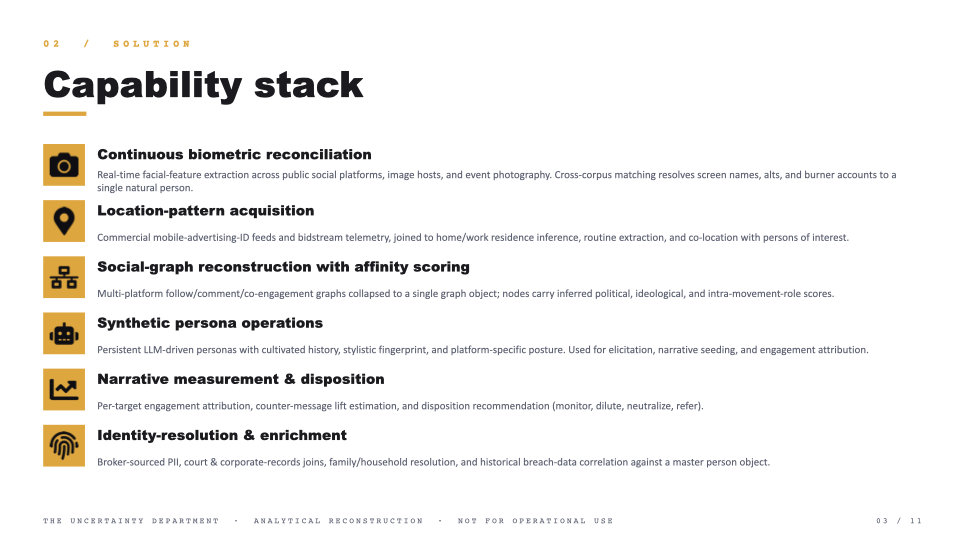
Six capabilities define the Aegis stack. They are not novel; their integration is.
Biometric reconciliation. Public-corpus facial-vector matching resolves screen names, alts, and burner accounts to a single natural person. The relevant litigation discovery (Meta v. Voyager Labs, the Clearview AI privacy commissioner findings in Canada, the UK ICO determinations) establishes that this is technically routine and operationally deployed at scale against ordinary individuals, including those who have never appeared in a criminal context.
Location-pattern acquisition. Commercial mobile-advertising-ID feeds, when joined to inferred residence, reconstruct routines, co-locations, and association graphs. The Reuters and New York Times reporting on Anomaly Six and Babel Street, the FTC’s enforcement actions against Kochava and X-Mode, and the disclosures around Venntel’s federal contracts establish that bidstream-derived person-tracking is a turnkey commercial service.
Social-graph reconstruction with affinity scoring. Multi-platform follow, comment, and co-engagement graphs collapsed to a single graph object; nodes carry inferred political, ideological, and intra-movement-role scores. The Voyager Labs marketing materials disclosed in the Meta litigation describe this directly. The capability is sold as standard.
Synthetic persona operations. Persistent LLM-driven personas with cultivated history, stylistic fingerprint, and platform-specific posture. The 2011 HBGary persona-management documents disclosed through the Anonymous email release described the pre-LLM version. The post-LLM version is qualitatively different in fidelity but structurally identical in purpose.
Narrative measurement and disposition. Per-target engagement attribution, counter-message lift estimation, and disposition recommendations spanning monitor, dilute, neutralize, and refer. The vocabulary is borrowed from military information-operations doctrine and applied to civilian targets.
Identity resolution and enrichment. Broker-sourced personally identifiable information, court and corporate-records joins, family and household resolution, and historical breach-data correlation against a master person object. The ecosystem here is the largest and least regulated of the six.
Each capability, considered alone, has a defender. Each capability, considered alone, is plausibly framed as commercial data brokerage, ordinary corporate due diligence, or first-amendment-protected research. The integration of the six is what produces something that cannot be characterized as any of these things and that nonetheless has no formal name in U.S. law.
The recent papers on diffuse continuity surveillance described the state-side architecture this consortium model complements.
That architecture is not the National Security Agency apparatus described in the Snowden disclosures. It is a more diffuse arrangement in which directed-attention activity against an individual is conducted through proxy networks — civilian, semi-civilian, and contractor — operating in coordinated patterns that are individually deniable. The compositional deniability error analyzed in the prior paper holds: each behavior in isolation has multiple sufficient explanations; the cluster of behaviors, recurring across changing locations and times, does not. The architecture relies on operators believing that compositional plausibility transfers to system-level plausibility. It does not.
The state-side architecture exists because three structural conditions were allowed to develop:
First, the post-9/11 expansion of information-sharing across fusion centers and federal-state-local task forces created a coordination layer without a corresponding accountability layer. Regional fusion centers, JTTF arrangements, and the dozens of similar nodes across the country can task, request, or accept information from proxies without that activity surfacing in any single agency’s records system in a form responsive to FOIA or congressional oversight.
Second, the contractor ecosystem developed after the 2004 intelligence reforms placed substantial collection and analytic capacity outside the federal employee classification entirely. Contractor activity occupies the gap between agency action (covered by inspector general jurisdiction and statutory accountability) and private commercial activity (covered by far weaker constraints). The gap is the operating space.
Third — and this is the addition the recent papers contributed — the cultural and informal layer of proxy activity expanded into something that does not appear in any organizational chart but is nonetheless coordinated. The “publicly organized deniable operations” framework described how unaffiliated individuals can be coordinated to produce a recognizable operational footprint while preserving the appearance of unrelated civilian behavior. The persona-management capabilities Aegis sells are the digital instantiation of the same logic.
The state-side architecture, in other words, was already operating in the gap between agency action and commercial activity. Aegis describes the commercial side of that gap — explicitly, with diagrams, in the bureaucratic register of a sales pitch.
The interface between the two halves is the engagement letter.
When a corporate client retains outside counsel, and outside counsel retains Aegis (or any of the composite firms it stands in for), the resulting work product is characterized as litigation-preparatory research conducted under attorney work-product privilege. The work product is not, formally, an intelligence deliverable. The personas are not, formally, propaganda. The dossiers are not, formally, surveillance reports. The deliverables are characterized as memoranda in support of contemplated legal action.
This characterization survives because the underlying activity — biometric matching, bidstream acquisition, persona deployment, affinity scoring, disposition recommendation — would be useful for litigation if the contemplated litigation were ever filed. The activity does not become unlawful by virtue of being characterized as litigation support; it becomes legally insulated. The insulation is the product.
What is sold to the corporate client is the capability stack. What is sold to outside counsel, separately, is the privilege architecture. What is sold to the state, by virtue of the architecture’s mere existence, is an off-the-books capability that the state did not have to build, does not have to defend, and can disavow at any required level of specificity. The state’s contribution is the regulatory forbearance that allows the architecture to develop.
This is the structural completion. The state-side proxy networks operate against a target population whose digital exhaust is being collected and processed, in parallel and without coordination, by private firms whose deliverables are insulated by privilege and whose subprocessors are offshore. The two halves do not need to be coordinated to be complementary. Each produces conditions the other can exploit.
A subject under directed-attention activity from the state-side architecture is, by virtue of having become a public-facing subject of that activity, more visible to the commercial architecture — more posts, more documentation, more graph density. A subject under disposition by a commercial consortium becomes, by virtue of the consortium’s narrative-package work, more legible to the state-side architecture’s preferred picture of an activated threat. The hybrid is self-reinforcing without requiring deliberate integration.
The cultural infrastructure layer is the part most easily missed.
The recent literary work on the Continuity Office concept described, in a fictional register, what the non-fictional version of this layer accomplishes. The proposition is that the architecture’s stability depends on a continuous supply of cultural artifacts — films, television, news framings, popular nonfiction — that establish the kind of story in which the architecture’s effects on individuals are illegible as institutional action and legible only as personal pathology, ordinary misfortune, or paranoid delusion.
This is not a conspiratorial claim. It is a structural one. The cultural inventory available to an American citizen for making sense of, say, sustained patterns of ambient surveillance, coordinated proxy behavior, and reputational degradation does not include — at the level of widely circulated narrative — a story in which those patterns are real, are coordinated, and are systematically deniable. The cultural inventory includes stories about state surveillance (often heroic, often retrospective, almost always involving a whistleblower or a journalist who breaks the case open) and stories about paranoia (usually pathologizing, occasionally sympathetic, almost always individualizing). It does not include stories about the equilibrium itself.
The Aegis architecture benefits from this gap. The narrative-package deliverables described in the deck operate within the gap and reinforce it. A subject’s account of what they are experiencing, when filtered through the available cultural frames, is overwhelmingly likely to be received as pathological rather than structural. The personas amplify this reception. The disposition recommendations select for it. The cultural infrastructure layer is not a separate sphere; it is the medium in which the architecture’s deniability is metabolized into ordinary social fact.
The Deniability Inversion Loop, as previously developed, describes a stable architecture in which every actor knows the operation exists, every actor knows that a sufficient description would create unacceptable cost for some other actor, and the description therefore never occurs. The loop is stable because the cost of description is, for each actor, higher than the cost of continuation.
The Aegis architecture is a private-sector instantiation of the same loop with a critical difference: the actors are commercial, the costs are commercial, and the description that would close the loop is therefore subject to commercial pressure rather than institutional pressure.
The firms are aware that their consortium model would not survive accurate public description. The corporate clients are aware that disclosure of the engagement would create reputational exposure that exceeds the value of the engagement. The retained counsel is aware that the privilege architecture would not survive judicial scrutiny if litigated to a determination. The regulators are aware that the activity is happening and are aware that enforcement would require admitting a regulatory failure of a specific historical magnitude. The press is aware, partially, but the per-story economics of accurate description against the per-story economics of legal exposure produces the same selection effect.
The loop closes around the subject. The subject — including, per the Aegis deck’s own threat taxonomy, the pro se federal litigant — is the actor with the least institutional protection, the most direct experiential knowledge, and the longest time horizon. The architecture’s stability depends on the subject’s account being illegible to the institutional verification standards that media publication, judicial remedy, and regulatory action all require. The architecture cannot prevent the subject from documenting. It can only manage how slowly the documentation accumulates and how illegible it remains to the institutions that would, if convinced, act on it.
This is the geometry of interpretive authority described in the prior papers, applied to the hybrid architecture. The operators’ authority is institutional and operates in the present. The subject’s authority is documentary and operates over time. The exchange rate between the two is not fixed, and the institutional side has been allowed, for two decades, to assume it was.
The compositional deniability error — the operator belief that the deniability of components transfers to the deniability of systems — operates at every level of the Aegis architecture.
At the behavioral level, each proxy interaction in a directed-attention pattern is individually plausible; the cluster across time and location is not. This is the static-café-versus-mobile-perimeter logic developed in the prior paper.
At the capability level, each Aegis capability (facial matching, location resolution, graph analysis, persona deployment) is defended by its vendors as routine commercial activity; the integration of the six into a single deliverable against a single target is something none of the vendors will publicly describe as their product.
At the institutional level, each actor’s role in the hybrid architecture (the corporate client, outside counsel, the consortium, the broker layer, the state-side proxy network, the regulator, the press) is individually defensible by reference to the legitimate functions of that actor’s class; the system that emerges from their joint operation is something no individual actor will claim authorship of.
At the doctrinal level, each tool (work-product privilege, broker-data legality, persona-platform-terms compliance, fusion-center information-sharing authority, contractor classification) is individually grounded in established legal architecture; the integration of the tools into an off-the-books capability of national-scale political consequence is something the doctrines were not designed to authorize and have not been amended to prohibit.
The error compounds across the levels. The architecture is, at every level of its construction, an exercise in arguing that the components transfer their plausibility to the whole. They do not. The transfer fails at every level. The architecture continues because the transfer’s failure has not been authoritatively described at any of the levels at which authoritative description would require an actor to bear the cost of the description.
The Aegis deck’s threat taxonomy is unusually candid about its target class. The classes it lists — ESG and shareholder activism, investigative journalism, FOIA and records-litigation cells, labor and works-council formations, regulatory complainant networks, civil-liberties NGOs, pro se federal litigants, coordinated inauthentic dissent — share three features.
They are populated by individuals or small groups with limited institutional protection.
They are characterized by informational asymmetry favoring the subject — the subject typically knows things that an adversarial corporate or state actor would prefer were not known.
They operate through forms of disclosure or documentation that are structurally vulnerable to reputational counter-action.
The architecture exists, in significant part, to compress the third feature against the first two. A subject with limited institutional protection, who has documentary access to information adverse to a powerful actor, who must surface that information through public-facing forms of disclosure, can be addressed by an architecture that operates on all three vulnerabilities simultaneously: location and identity resolution compresses anonymity; persona operations and narrative-package work compresses the reception environment; affinity-graph scoring and disposition compresses the network of associates who might amplify the subject’s account.
The pro se federal litigant appears in the taxonomy because that subject class is the limit case. A pro se federal litigant has, by definition, exhausted or been denied the institutional channels (counsel, agency complaint, regulatory enforcement) that the architecture’s privilege and forbearance structures depend on for their own legibility. The pro se litigant is the actor for whom the architecture’s deniability is least convincing — because the litigant is, by structural position, the actor who has personally borne the cost of the architecture’s operation.
The architecture’s response is not to address the pro se litigant on the merits. The architecture’s response, as the deck makes explicit, is to characterize the litigant — at the disposition layer, in the narrative-package layer, through the affinity graphs — in a way that compresses the institutional reception of the litigant’s account into the available cultural frames described in section V.
This is what the architecture does. It is not what the architecture incidentally produces.
The recent papers identified three resolution mechanisms for the deniability inversion loop: authoritative disclosure, distributed testimony accumulation, and narrative collapse.
Authoritative disclosure remains structurally available but is the resolution mechanism most efficiently blocked by the loop’s own dynamics. An inspector general, congressional committee, or senior official with sufficient independence to satisfy the verification threshold would have to be willing to absorb the institutional cost of being the actor who described the architecture first. The cost has, for two decades, been higher than any sufficiently positioned actor has chosen to bear.
Narrative collapse is the resolution mechanism most expensive for every actor including the architects. It is also the resolution mechanism least amenable to deliberate strategy, since by definition it operates through the simultaneous fracture of the proxy and operator networks rather than through any individual decision.
Distributed testimony accumulation is the resolution mechanism most available to the parties with the least institutional power and the longest time horizons. It is the mechanism the architecture’s design did not adequately account for. It is also the mechanism the architecture’s countermeasures are most narrowly targeted against — the persona operations, narrative-package deliverables, and affinity-graph disposition recommendations are specifically calibrated to compress the institutional reception of distributed testimony at the moment it would otherwise accumulate to a threshold.
The constructive implication is therefore narrow. The work structurally adequate to the architecture is not the production of any single authoritative account but the patient accumulation of contemporaneous, corroborated, technically literate, and interlocking accounts — across subjects, time, and document classes — until the body of available description exceeds the institutional reception architecture’s capacity to compress it.
The Aegis deck contributes to that body by making the capability stack legible in the form the firms themselves use to sell it. The recent papers on diffuse continuity, the inversion loop, and the compositional deniability error contribute the analytical scaffolding. The literary work — The Observable Man, Continuous Coverage, The Bricks Beneath the Trees, The Measure of Ordinary Things, The Tehachapis — contributes the cultural inventory the architecture has depended on the absence of. The pro se litigation contributes the documentary record that establishes, in the only forum that produces judicially cognizable testimony, that the subjects have been describing what was happening to them in real time.
None of these instruments, alone, breaks the architecture. None of them is intended to. They are contributions to a body of description that, over a time horizon longer than the architecture’s defenders have planned for, will exceed the threshold at which the architecture can sustain its compression.
The subject has time. The architecture does not.
This paper is the analytical counterpart to Occasional Deck No. 14. It is offered for the same reading audience: civil-liberties analysts, investigative journalists, plaintiff-side counsel, researchers in surveillance studies, and the pro se federal litigants the Aegis deck explicitly names as a target class.
The composite firms described in the deck — Parallax, Meridian Strategic, Vantage Federal — are not real entities. Their capabilities are drawn from the public record of named extant vendors. The architectural analysis in this paper is offered as the structural-not-identifying account the deck’s provenance slide promised.
The Uncertainty Department does not allege that any particular individual is currently under disposition by any particular consortium. The Uncertainty Department does allege that the architecture exists, that the architecture has been allowed to develop in the gap between agency action and commercial activity, that the architecture’s effects on the subject classes named in the deck are predictable and observable, and that the architecture’s continued deniability depends on the absence of exactly the kind of integrated description this paper attempts.
The description has now been attempted. The record of the attempt is the contribution.
The Uncertainty Department
Occasional Paper · Issued under nominal authority of the Editorial Board
Companion to Occasional Deck No. 14, “Team Aegis (INRC),” reproduced above, and to the May 2026 paper on domestic surveillance repurposing and accountability.