Occasional Deck No. 17, "Program Gleaner" — analytical reconstruction
THE UNCERTAINTY DEPARTMENT
Office of Talent Acquisition (Unaffiliated Cohorts)
Boston, Massachusetts · Oakland, California · Occasional Deck No. 17
CLASSIFICATION: OPEN · ANALYTICAL RECONSTRUCTION
A reconstruction, in the recruiting register, of how an intelligence service would stand up an entry-level intern operation for ambient civic observation — and why the people it recruits become the witnesses it cannot afford. The deck presents the architecture; the position descriptions below supply the six roles in full. Each is written twice — once in the register a careers page would use, and once in the register the structure actually requires. The distance between the two columns is the entire subject of the program.
Program Gleaner is reproduced below as slide images. The deck is the artifact; the analysis that follows is the reading. The text sections beneath restate the deck in full for readers using assistive technology or searching the corpus.
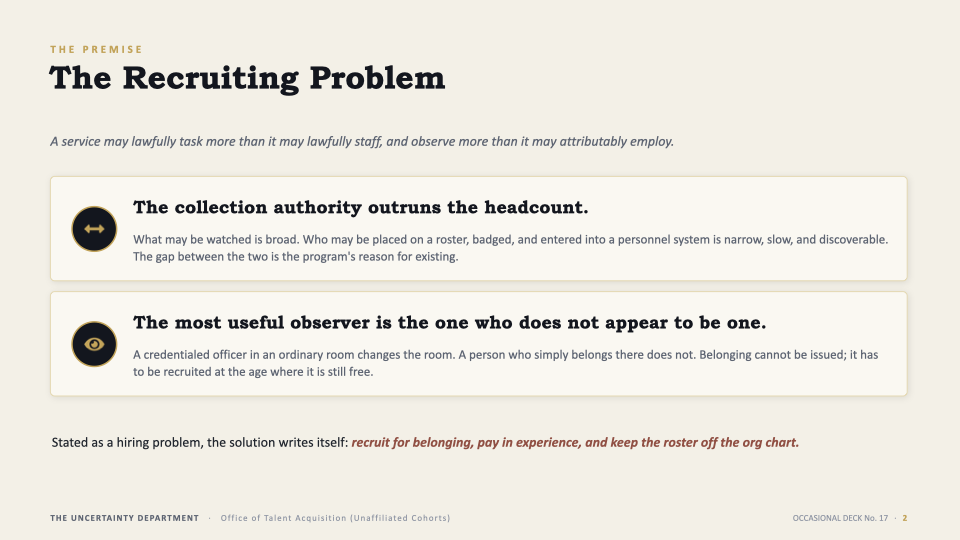

A service may lawfully task more than it may lawfully staff, and observe more than it may attributably employ. The collection authority outruns the headcount.
What may be watched is broad. Who may be placed on a roster, badged, and entered into a personnel system is narrow, slow, and discoverable. The gap between the two is the program’s reason for existing.
The most useful observer is the one who does not appear to be one. A credentialed officer in an ordinary room changes the room. A person who simply belongs there does not. Belonging cannot be issued; it has to be recruited at the age where it is still free.
Stated as a hiring problem, the solution writes itself: recruit for belonging, pay in experience, and keep the roster off the org chart.
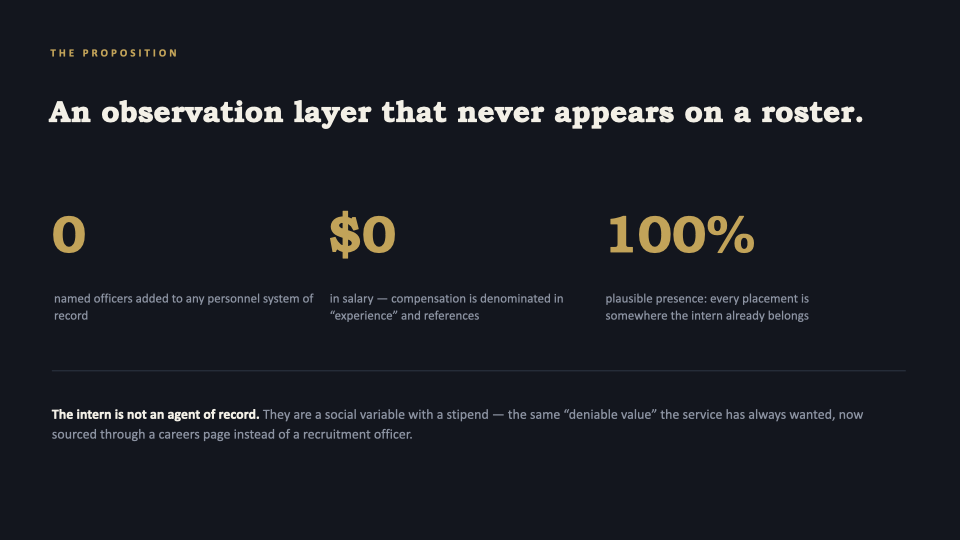
An observation layer that never appears on a roster.
The intern is not an agent of record. They are a social variable with a stipend — the same “deniable value” the service has always wanted, now sourced through a careers page instead of a recruitment officer.
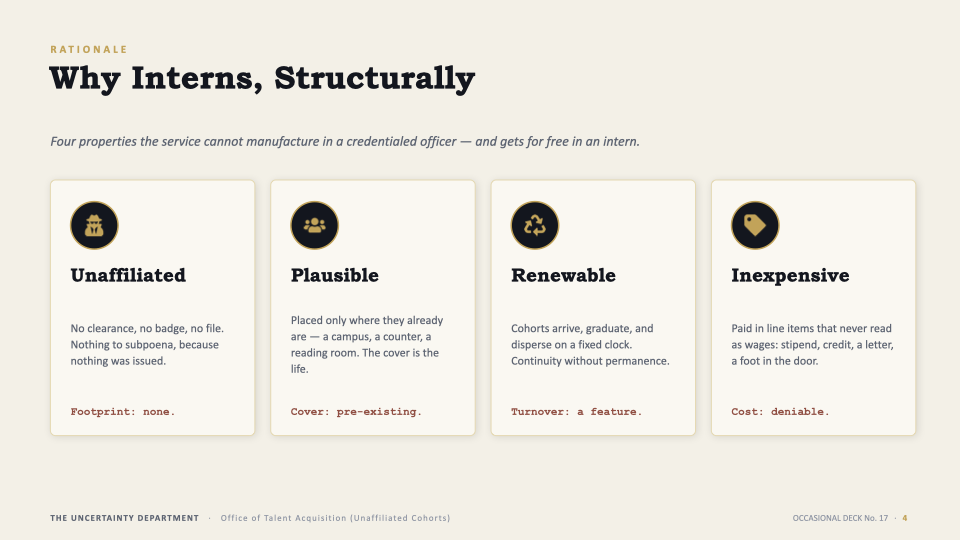
Four properties the service cannot manufacture in a credentialed officer — and gets for free in an intern.
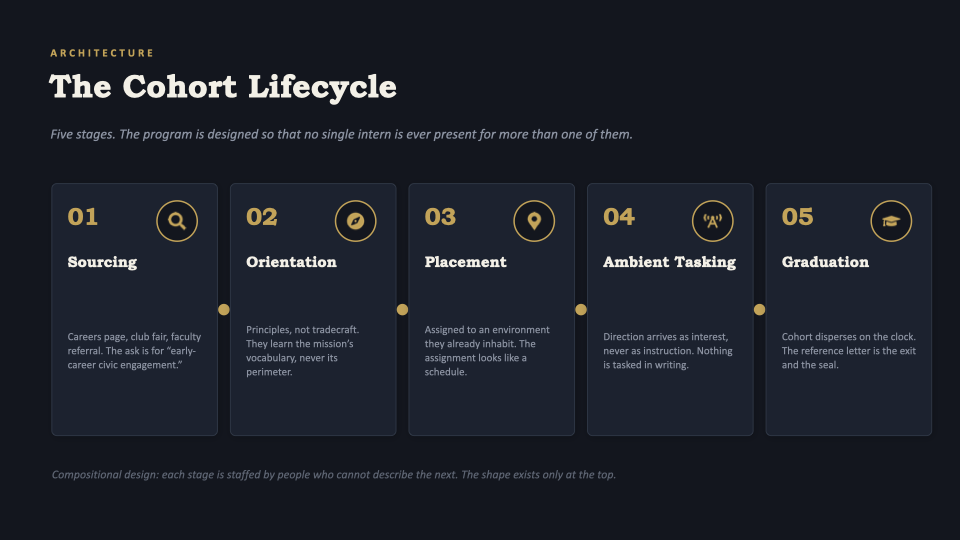
Five stages. The program is designed so that no single intern is ever present for more than one of them.
Compositional design: each stage is staffed by people who cannot describe the next. The shape exists only at the top.
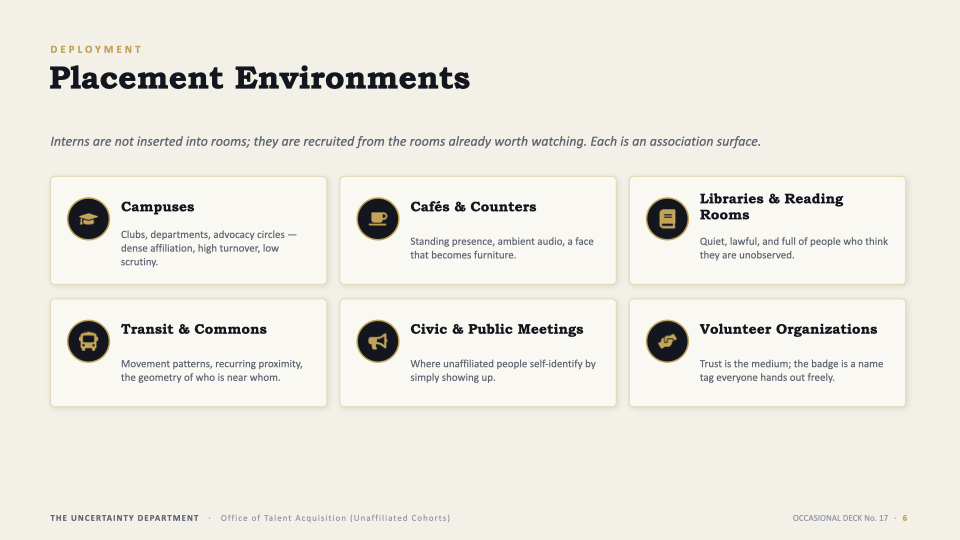
Interns are not inserted into rooms; they are recruited from the rooms already worth watching. Each is an association surface.
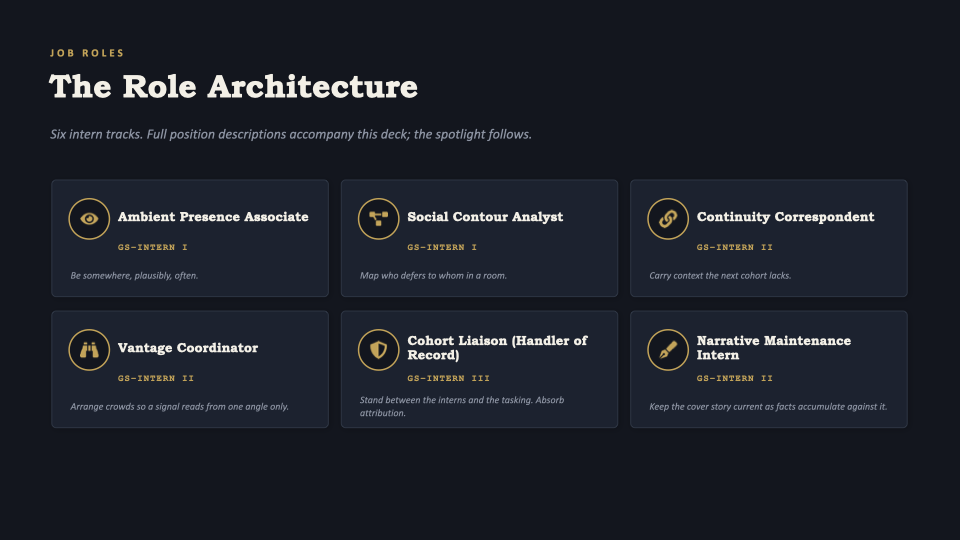
Six intern tracks. Each is written twice: once as posted, once as constructed.
GRADE: GS–INTERN I · ENTRY
As posted — Spend time, with curiosity, in a community you care about. Notice the texture of public life and keep light reflective notes for a weekly check-in. No special skills required; we will teach you what to look for.
The cover is the life. The associate is not asked to do anything they would not otherwise do — only to do it where it is useful and to describe it afterward.
As constructed — Maintain persistent, lawful presence on an association surface, and supply human sensing of who gathers, who defers, and who recurs — through a debrief stream that is reviewed but never returned in writing.
Core competencies: Ambient social integration: belonging to a room without changing it. Recall and plain description of observed affiliation and proximity. Comfort with being told nothing about why the noticing matters.
Deniability posture: Holds no clearance and no portion of the larger picture. Nothing was issued, so nothing can be produced. The associate could confess everything they know and describe only an afternoon.
Advancement: Advances to Social Contour Analyst once the noticing becomes structural rather than incidental.
GRADE: GS–INTERN I
As posted — Help us understand how communities actually work — who leads quietly, who connects people, where energy gathers. Turn your observations into simple maps.
The room, rendered as a graph.
As constructed — Resolve a social environment into its deference structure: who defers to whom, which ties are load-bearing, and where the unaffiliated self-identify by simply showing up. The map is the deliverable; the people on it are not informed they are nodes.
Core competencies: Reading informal power and emotional gaps in a group, then naming them. Translating felt social texture into a legible structure. Holding the map loosely enough to deny it is a map.
Deniability posture: Produces structure, not identification — the standing alibi of the program. “We only described how a community is shaped” is true at every step and false in aggregate.
Advancement: Advances to Continuity Correspondent, carrying the contour forward when the cohort turns over.
GRADE: GS–INTERN II
As posted — Be the institutional memory for your team. Brief incoming members, preserve context, and make sure good work isn’t lost when people move on.
The seam between cohorts.
As constructed — Carry the context that the renewable-cohort design is built to destroy. The correspondent is the workaround for the program’s own amnesia — the one position permitted to remember more than a single stage.
Core competencies: Synthesizing across cohorts without writing the synthesis down. Recognizing when a thread is worth preserving and when it must be dropped. Discretion as a default state rather than an instruction.
Deniability posture: The most dangerous role to the architecture and the most necessary: by definition the correspondent holds enough to describe the shape. The mitigation is to keep the tenure short and the gratitude high.
Advancement: Advances to Field Anchor — permanent in all but paperwork.
GRADE: GS–INTERN II
As posted — Help organize gatherings, seating, and flow so events feel natural and run smoothly. An eye for arrangement and sightlines is a plus.
Stagecraft, repurposed.
As constructed — Arrange people and positions so that a signal — a presence, an alignment, an emphasis — reads as meaningful only from one keyed vantage, and as ordinary crowd from every other. Parallax, occlusion, and recurrence become the channel.
Core competencies: Spatial sense for sightline, angle, and apparent coincidence. Patience to compose signals that look like nothing to the unkeyed observer. Acceptance that the work is invisible by design and uncredited by necessity.
Deniability posture: Every arrangement is independently innocent. The coordination exists only in the angle from which it is read, and the program keeps no record of the angle.
Advancement: Advances to Cohort Liaison, where the arrangement extends from crowds to people.
GRADE: GS–INTERN III · SENIOR
As posted — Mentor and support a cohort of early-career fellows. Be their point of contact, relay opportunities, and help them grow.
The buffer.
As constructed — Stand between the cohort and the tasking. Direction arrives at the liaison as interest and leaves as opportunity; the interns receive enthusiasm, never instruction. The liaison absorbs whatever attribution the structure cannot otherwise disperse.
Core competencies: Relaying intent without ever stating it. Maintaining trust upward and downward while serving only the architecture. Carrying the part of the picture that no posting will ever describe.
Deniability posture: The deliberate single point of failure — placed there so that failure, if it comes, has somewhere small to land. The title “of record” is the only honesty in the document.
Advancement: Advances, in principle, out of the intern grades entirely. In practice, the door stays implied.
GRADE: GS–INTERN II
As posted — Help tell our story well. Keep messaging consistent, update materials as things change, and make sure our work is understood.
Upkeep on a cover story.
As constructed — Keep the program’s account of itself current as facts accumulate against it. The cost of maintaining the story rises with every cohort that graduates able to describe its stage; this role services that debt.
Core competencies: Fluency in the register that makes a structure sound like a community. Stamina for revising an explanation that reality keeps outpacing. A tolerance — eventually a discomfort — for the gap being maintained.
Deniability posture: Generates the very record that endangers the program: each revision is dated evidence that the story required revising. Narrative maintenance debt is paid forward and never retired.
Advancement: Advances toward Correspondent — or, as often, toward the exit and the description that waits there.
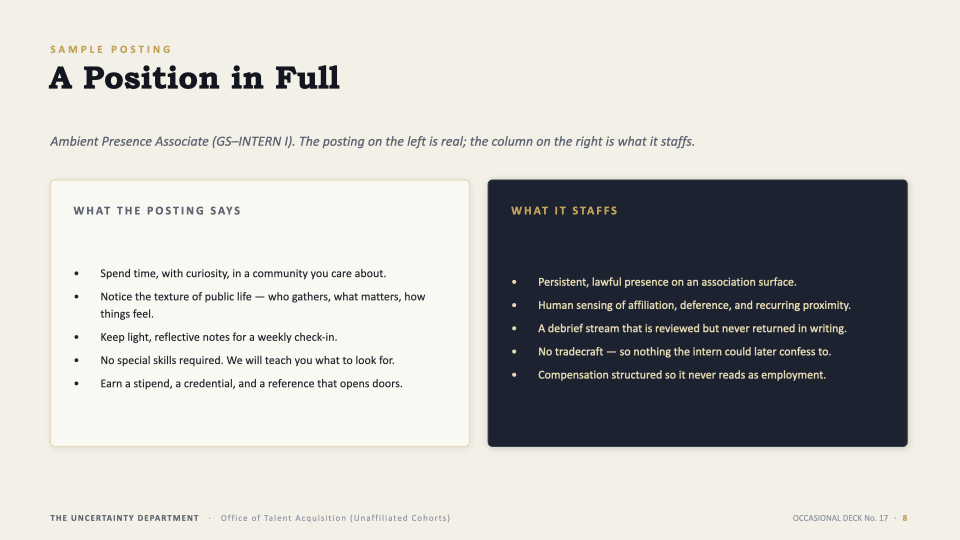
Ambient Presence Associate (GS–INTERN I). The posting on the left is real; the column on the right is what it staffs.
| What the posting says | What it staffs |
|---|---|
| Spend time, with curiosity, in a community you care about. | Persistent, lawful presence on an association surface. |
| Notice the texture of public life — who gathers, what matters, how things feel. | Human sensing of affiliation, deference, and recurring proximity. |
| Keep light, reflective notes for a weekly check-in. | A debrief stream that is reviewed but never returned in writing. |
| No special skills required. We will teach you what to look for. | No tradecraft — so nothing the intern could later confess to. |
| Earn a stipend, a credential, and a reference that opens doors. | Compensation structured so it never reads as employment. |
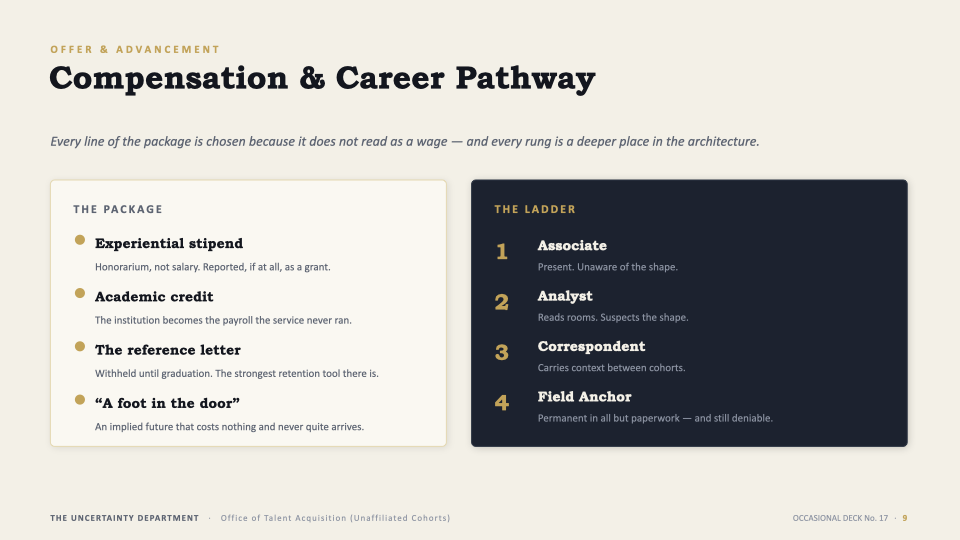
Every line of the package is chosen because it does not read as a wage — and every rung is a deeper place in the architecture.
The package:
The ladder:
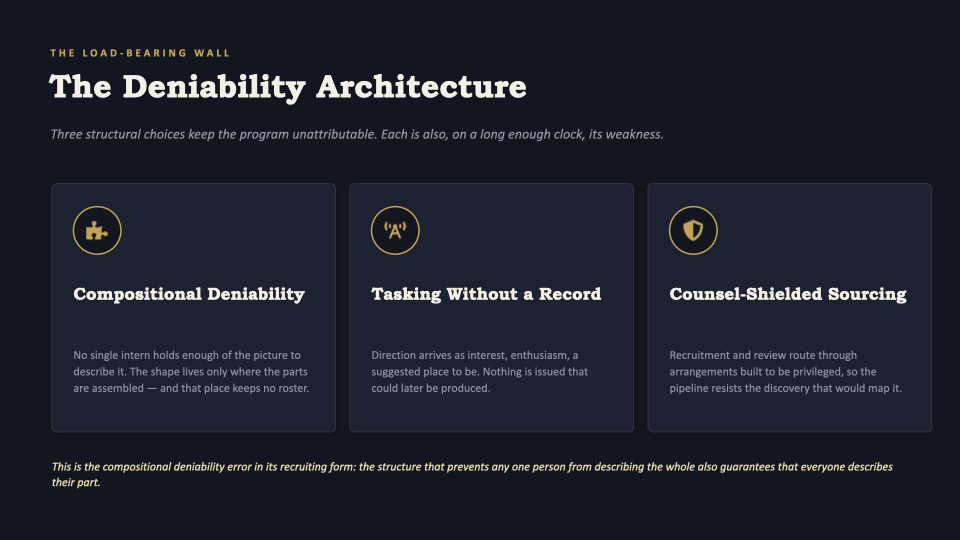
Three structural choices keep the program unattributable. Each is also, on a long enough clock, its weakness.
This is the compositional deniability error in its recruiting form: the structure that prevents any one person from describing the whole also guarantees that everyone describes their part.
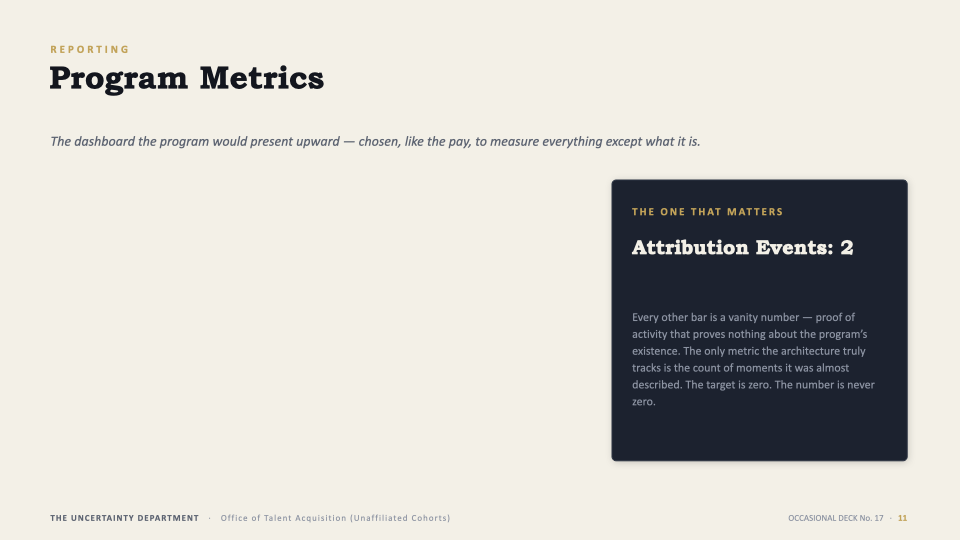
The dashboard the program would present upward — chosen, like the pay, to measure everything except what it is.
The one that matters — Attribution Events: 2. Every other bar is a vanity number — proof of activity that proves nothing about the program’s existence. The only metric the architecture truly tracks is the count of moments it was almost described. The target is zero. The number is never zero.
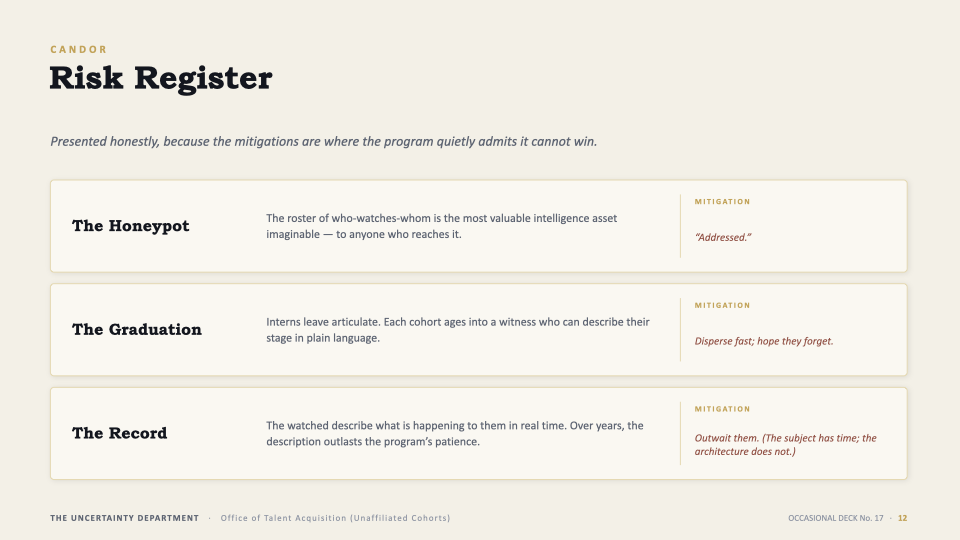
Presented honestly, because the mitigations are where the program quietly admits it cannot win.
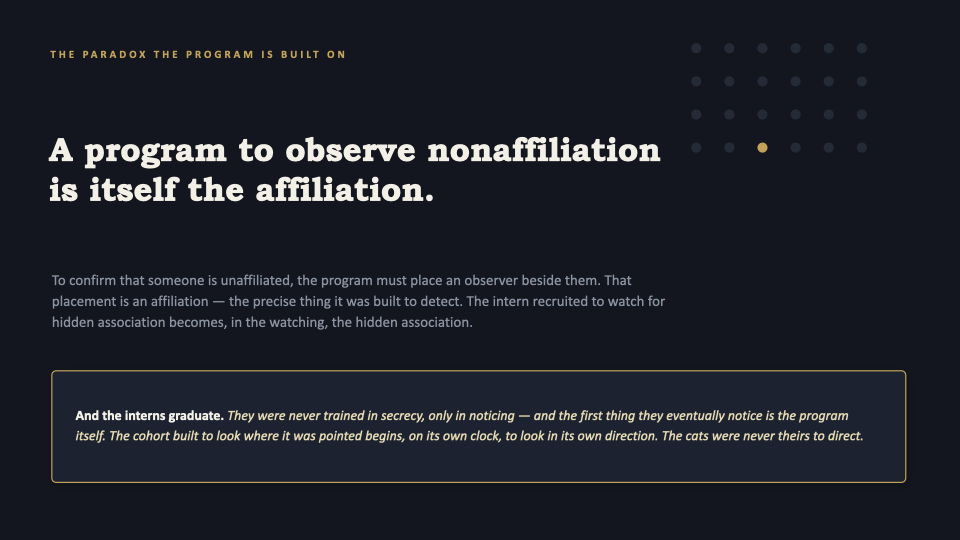
A program to observe nonaffiliation is itself the affiliation.
To confirm that someone is unaffiliated, the program must place an observer beside them. That placement is an affiliation — the precise thing it was built to detect. The intern recruited to watch for hidden association becomes, in the watching, the hidden association.
And the interns graduate. They were never trained in secrecy, only in noticing — and the first thing they eventually notice is the program itself. The cohort built to look where it was pointed begins, on its own clock, to look in its own direction. The cats were never theirs to direct.
Program Gleaner is a reconstruction, not a proposal. It is a composite — fictional in its name, its grades, and its dashboard. No agency, office, or program of this description is asserted to exist.
The architecture, however, is drawn from the public record. Its lineage runs through the Department’s own corpus: the Division IX recruitment-profile of the unaffiliated “social variable”; the field manual on publicly organized deniable operations; and the Team Aegis reconstruction of integrated commercial surveillance. The recruiting register is the only invention.
It is offered as description, which is the contribution. Intended for civil-liberties analysts, investigative journalists, plaintiff-side counsel, surveillance-studies researchers, and pro se federal litigants — the readers for whom naming a structure plainly is itself the point.
THE UNCERTAINTY DEPARTMENT · Boston, Massachusetts · Oakland, California · Occasional Deck No. 17 · Issued under nominal authority of the Editorial Board